
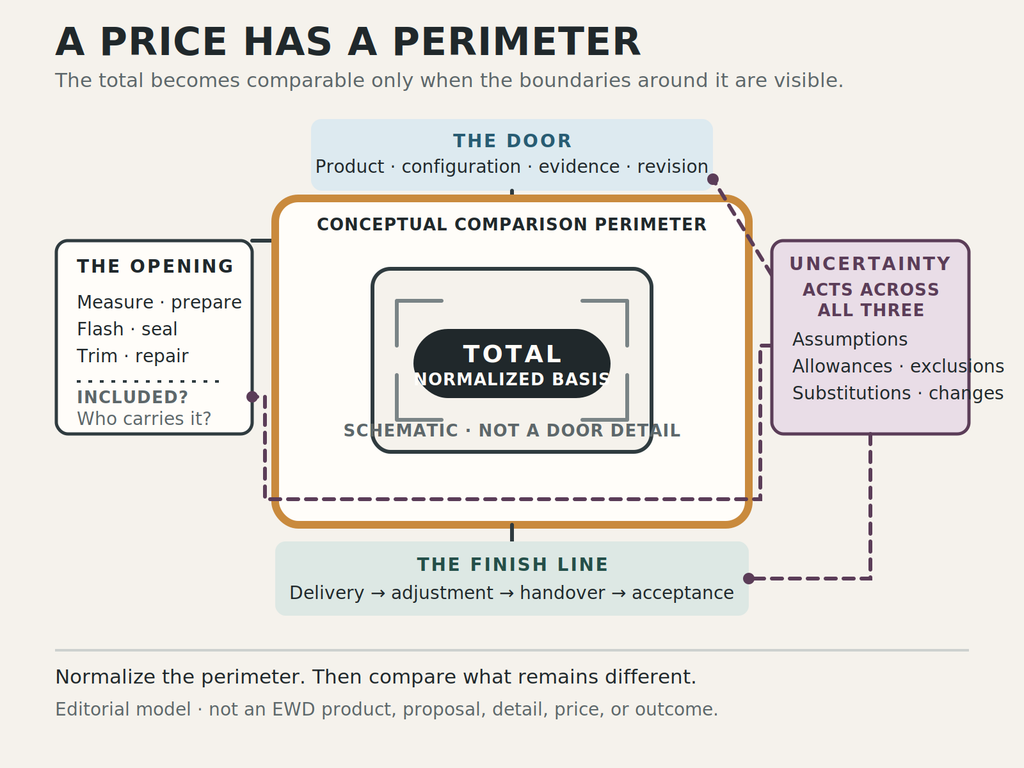
The total sits inside a conceptual perimeter: the specified door, work around the opening, and the agreed finish line, with named uncertainty acting across all three.
Two proposals can place the same architectural opening at the top of the page and still price different jobs.
One may include a named door system, field measurement, delivery, installation, exterior water-management work, interior repair, adjustment, and a service route. The other may price the fabricated door and leave the opening around it to somebody else. The lower total is not necessarily better. The higher total is not necessarily more complete.
The problem is not price. It is the invisible boundary around the price.
The short answer: Compare premium-door totals only after each proposal identifies the exact door, the work around the opening, the finish line, the exclusions, and the person responsible at every handoff. If those boundaries differ, normalize the scope before you compare the numbers.
That sounds procedural. In practice, it protects the part of the project you will touch every day: the handle that should land at a natural height, the panel that should move without scraping, the threshold that meets the finished floor, and the wall that must direct water back outside.
“Estimate,” “quote,” and “proposal” do not always mean the same thing from one seller to another. Instead of relying on the heading, ask what the document is ready to support, which assumptions remain, and what—if anything—your signature authorizes. Get that answer in writing before work or fabrication begins.
A preliminary number can be useful before the design is settled. It does not need final hardware codes, approved drawings, or field-verified dimensions. It does need a visible basis:
EWD’s project consultation allows rough dimensions, photos, plans, and early-stage questions to begin the conversation. Rough information is appropriate for narrowing options. It is not the same as a fabrication release.
At this stage, the document should be specific enough to place beside another proposal without guessing which bidder included what. Follow the CSLB’s consumer guidance by comparing each seller against the same plans, specifications, and scope of work. If one proposal assumes supply-only and another carries delivery, installation, finishes, or service, separate those differences before comparing totals.
When a proposal includes contracting work in California, verify the contractor license and any applicable Home Improvement Salesperson registration through the CSLB Check a License tool. A number printed on a document is not a substitute for checking its current record.
At contract stage, the document should establish the price basis, included and excluded scope, responsibilities, and the path for resolving any dimensions or selections that remain open. Fabrication is a later gate: before release, the controlled document set should resolve field-verified dimensions and every fabrication-critical choice, which may include a dimensioned elevation, handing or operating direction, threshold section, hardware schedule, glass specification, finish selections, approved revisions, and the responsibility for adjacent work.
Do not let the three stages collapse into one. An early estimate can be honest without being complete. A release-ready order cannot leave a fabrication-critical choice unidentified or uncontrolled.
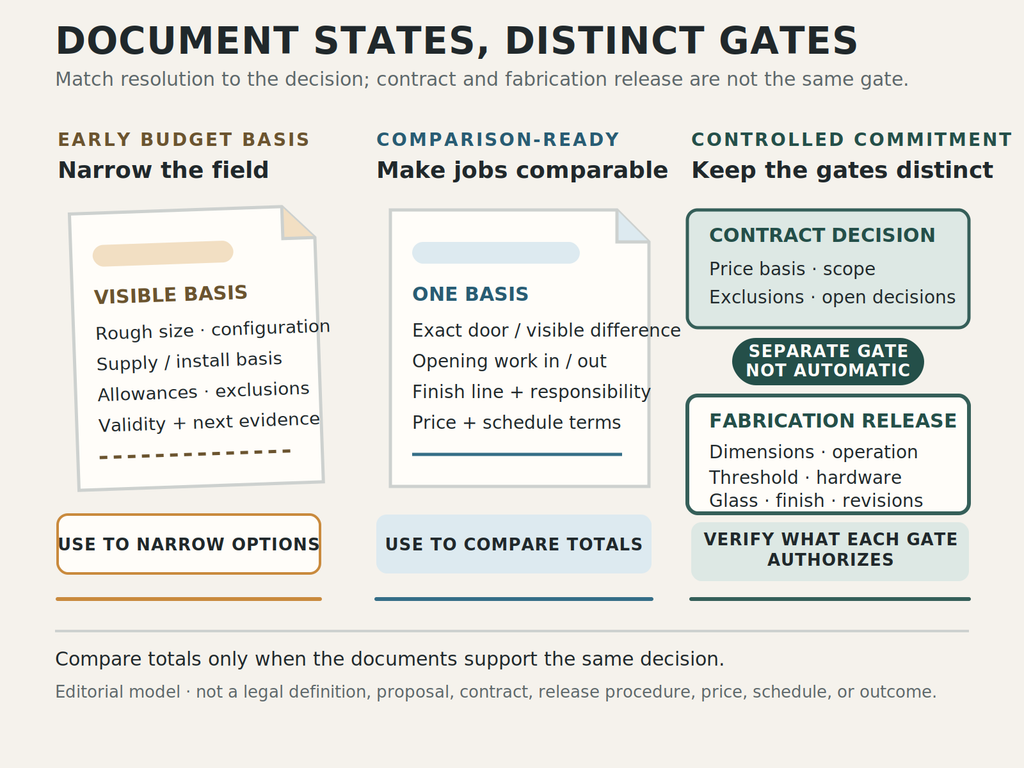
Three numbers may be honest at different stages; compare totals only when the documents support the same decision.
A useful comparison does not require a contractor to reveal internal margins. It requires the buyer to see the perimeter of the promise.
| Boundary | The proposal should answer | What happens when it is vague |
| The door | What exact product and configuration are being priced? | Different systems or options look like a price difference. |
| The opening | Who measures, prepares, supports, flashes, seals, trims, and repairs? | Work migrates between trades or appears later as an extra. |
| The finish line | What condition marks delivery, installation, adjustment, handover, and acceptance? | “Installed” ends before the door is ready for normal use. |
| The uncertainty | Which assumptions, allowances, exclusions, substitutions, and change triggers remain? | Risk stays hidden until the project is committed. |
Normalize these four boundaries, then compare price.
“Large aluminum door,” “European system,” or “pivot entry” describes a category, not an order.
A comparison-ready product schedule should identify the fields that make the quoted door distinct:
Not every field applies to every door. The point is to identify the selected configuration, not to produce a decorative specification sheet.
If the proposal makes energy-performance claims, ask which NFRC-certified product line and Certified Products Directory record supports the represented rating, including the applicable rated or calculated size basis. The directory searches current certifications; use its historical-label verification path when an older NFRC label must be checked. If the proposal makes air, water, or structural claims, distinguish an FGIA/AAMA certification listing from an independent test report: the directory lists certified products, while the applicable report must come from the proposer or manufacturer. Ask for the applicable standard and edition, specimen size and configuration, and represented metric—not a family brochure. These are different evidence lanes, and neither is proven by a product-family photograph or marketing page.
If a rating matters to the purchase, the proposal should identify the record, the represented metric, and the configuration it covers. The point is not to make the buyer a testing expert; it is to make the evidence traceable to the door being priced.
Require one controlled package. A clean version might include:
If two documents disagree, the package should say which one controls. “Latest” is not a revision number.
A door does not perform in isolation. It meets structure, floor, wall, drainage plane, finishes, electrical work, and other trades.
The proposal should state whether each material interface is included or excluded. For excluded work, the buyer or project team should confirm which separate contract carries it before comparing totals. Typical questions include:
Flashing, water-management, and air-sealing work can sit with different trades. The proposal should make included and excluded tasks visible rather than rely on “included” or “by others” as complete answers. The PNNL flashing guidance and rough-opening air-sealing guidance are useful reminders that these interfaces must be coordinated. When work is excluded, the buyer, general contractor, architect, or owner’s representative should confirm the responsible separate contract.
A proposal should not make a salesperson the structural engineer or code authority. Structural adequacy, permits, egress, accessibility, safety glazing, water management, and project-specific compliance belong in the applicable project documents and with the appropriate professionals—not in a floating line such as “per code.”
“Installation included” can describe a range of endpoints.
For one bidder, it may mean fastening the frame. For another, it may extend through perimeter sealing, panel installation, hardware adjustment, trim, protection, cleaning, operating demonstration, and a punch-list response. The comparison must reveal the endpoint.
Ask the proposal to define:
This is not a demand for a theatrical commissioning ceremony. It is a way to prevent the finish line from moving. A premium door is not complete merely because it occupies the opening; it should reach the condition defined in the agreement.
Some uncertainty is unavoidable, especially in replacement work. Concealed damage may not appear until the existing assembly is removed. A manufacturer may confirm a detail only after final engineering. A finish may remain an allowance while the design develops.
The honest response is not to pretend the uncertainty has disappeared. It is to give it a name and a process.
List the facts on which the price depends: opening condition, access, work hours, utilities, floor readiness, substrate, structural design, finish selections, and the availability of other trades.
An allowance should name what it covers, its value or pricing basis, and what happens when the selection exceeds or falls below it. “Hardware allowance” without a basis does not create a comparable number.
Exclusions should be specific enough to assign elsewhere. “Others” is not a responsible party.
If substitutions are allowed, define the approval path and the evidence required to show equivalence. A lower-cost substitute can change appearance, operation, dimensions, testing, warranty, and lead-time assumptions.
The proposal or contract should define how concealed conditions are documented, priced, approved, and scheduled. A useful change record names the changed scope, the price adjustment, the schedule effect, and the person who must approve it before the changed work proceeds.
The governing question is simple: Who owns the next decision when an assumption stops being true?
“Ten-year warranty” or “limited lifetime warranty” is not enough information to compare support. Draw two separate lanes: the remedy for a product defect, and the responsibility for installation, adjustment, adjacent work, and first response. One document may not cover both.
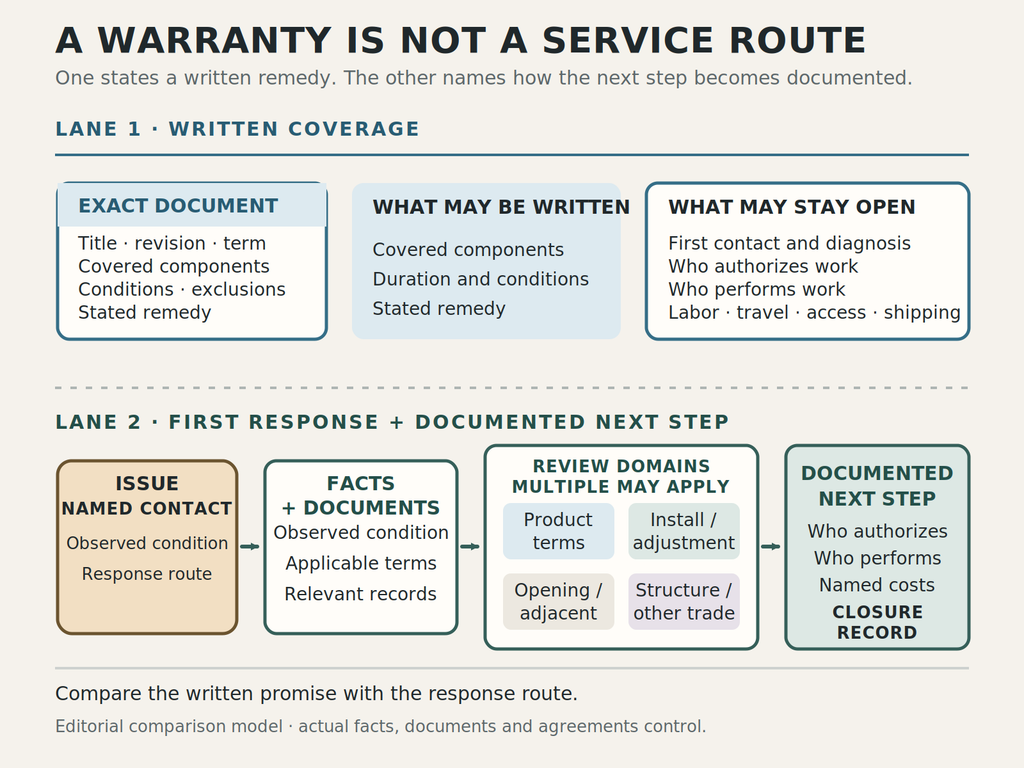
A warranty states a written remedy; the response route uses facts and documents to identify every review domain that may apply and record the next step.
The Federal Trade Commission’s warranty guidance advises buyers to review the written warranty before purchase and to ask what parts and problems it covers, how long coverage lasts, whether conditions or maintenance requirements apply, how to obtain service, and whether repair-related costs remain with the buyer.
For a premium door, ask each proposal to identify:
Written manufacturer warranties vary. The proposal should state what is included rather than treat a headline warranty term as complete service coverage.
Place each proposal in one column. Add a third column for the normalized requirement.
| Comparison field | Proposal A | Proposal B | Normalized requirement |
| Document stage and validity | Same maturity and date basis | ||
| Exact door/configuration | Same product schedule or explicit difference | ||
| Performance evidence | Same claimed metric, record, size/configuration basis | ||
| Measurement and order release | Named owner, approved dimensions and revisions | ||
| Opening and water-management scope | Included or excluded; separate contract confirmed for excluded tasks | ||
| Delivery through acceptance | Same finish line and handover documents | ||
| Assumptions, allowances, exclusions | Same basis or visible adjustment | ||
| Price basis and pass-through costs | Same tax, freight, delivery, permit, engineering, and fee basis—or a visible adjustment | ||
| Schedule and payment basis | Same lead-time assumptions, validity period, deposit, and milestone basis | ||
| Warranty and service route | Same components, costs, responsibilities, and claim path | ||
| Total after normalization | Compare only after every material difference above is visible |
Do not force identical products into false equivalence. A different threshold, operating layout, finish, or service boundary may be the reason one proposal is worth more. The sheet should expose the difference, not erase it.
They are not competing documents yet. Ask both sellers to price from the same information set.
A category name without series, dimensions, operation, threshold, glass, hardware, finish, and revision leaves room for accidental or strategic substitution.
Ask what condition the opening, wall, finishes, hardware, and site will be in when the installer leaves.
An allowance without an included quantity, specification, or value hides rather than manages uncertainty.
A warranty document matters. So does the person who answers when a panel drags, a lock does not engage, or water appears where it should not.
A generic compliance statement does not identify the jurisdiction, permit path, exact configuration, or responsible professional. Ask the proposal to name the applicable basis and who is responsible for verifying it.
A detailed proposal is not always the right first document.
The poor fit is not the shorter document. It is the document that appears final while its important boundaries remain unstated.
Ask four questions:
If any answer is no, the totals are not ready to compete. Request re-pricing on a shared basis, resolve the unclear boundary, or knowingly accept and price the difference before choosing.
A premium door quote earns trust by showing its edges. The door may be the visual center of the project, but the decision lives at the perimeter: where product becomes opening, installation becomes acceptance, and a warranty becomes an actual response.
If the product direction is still open, start with EWD’s bi-fold versus lift-slide guide. If you already have an opening, plans, rough dimensions, or competing proposal questions, request an EWD project consultation.
A consultation begins the pricing conversation. Before contract or order release, use the four-boundary method above to confirm what the final document includes, excludes, and assigns.


 (310) 200 3931