
The window is closed. You can see it is closed — the latch is engaged, the frame sits flush against the sill, the condensation from last winter is gone. The street outside is doing what streets do in the early morning: a bus accelerates, a truck downshifts, someone’s car alarm runs its full sequence.
And the room is still loud.
This is not always a glass problem. It is sometimes a glass problem, and replacing the panes or the entire unit with an acoustic-rated assembly can reduce what passes through that opening. But the room can receive sound through more than one path. Unless those other paths are investigated, a higher-rated glazing package may produce a quieter window that does not produce a quieter room. That is a possibility to check, not a diagnosis this article can make.
The short answer: Before specifying acoustic glass, treat the opening as one part of a larger assembly: glass, frame and seals, installation perimeter, ventilation openings, and surrounding envelope. A laboratory rating is evidence about a tested specimen under defined laboratory conditions. The installed room can be affected by source spectrum, opening state, frame and seal condition, installation perimeter, adjacent construction, ventilation, and the room itself. A test report is not a promise about the installed outcome, and a homeowner observation cannot identify, rank, or exclude a path.
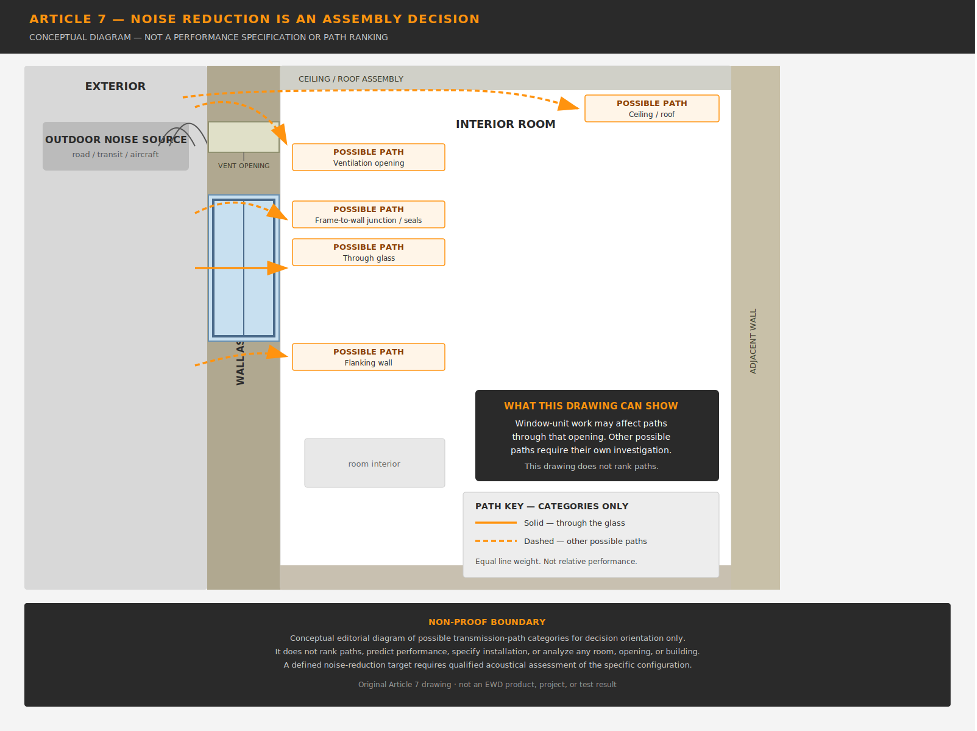
Sound can travel through the glass, through frame joints, through ventilation openings, and through other parts of the envelope — replacing the glass changes only the path through that glass.
Non-proof boundary: Conceptual diagram only; does not constitute a performance prediction, path ranking, installation specification, or acoustical analysis for any specific room, opening, building, or source.
A window is not a wall. It is an interruption of the wall — a place where the solid assembly is replaced by a glazed unit with its own transmission characteristics, its own frame-to-wall junction, and, in many cases, an operable component whose opening state changes which paths are present.
A field study of 102 Swiss residents exposed to road traffic noise found median outdoor-to-indoor sound level differences of 10 dB(A) for open windows, 16 dB(A) for tilted windows, and 28 dB(A) for closed windows. For open and tilted conditions, building and window characteristics affected the result. For closed windows, the study identified outside level, frame material, window gaskets, and number of windows among the relevant parameters. [Locher et al., 2018 — Differences between Outdoor and Indoor Sound Levels for Open, Tilted, and Closed Windows]
Those numbers — 10, 16, 28 dB(A) — are medians across that study’s measurement scenarios. They are not a specification for any particular window or room, and they should not be transferred to an expected installed result. They show that operating state was a material variable in this field study. The study does not quantify any product rating, perimeter defect, or installed-room outcome, and it does not compare those medians with a glass rating or with a failed seal.
A higher-rated glazing package left open or tilted for ventilation is no longer in the closed condition a laboratory report typically describes. Perimeter gaps and seals that do not engage are separate possible paths. They are not equivalent to a tilted window, and this article does not rank them. State, seals, and installation perimeter each deserve investigation on their own evidence.
The Federal Highway Administration’s Audible Landscape describes acoustical construction as the treatment of walls, windows, doors, ceilings, and floors as a group to reduce interior noise impacts, and notes that dense materials and airspaces within materials are principal techniques. [FHWA Audible Landscape: A Manual for Highway Noise and Land Use, Chapter 2] The window is one treated component inside a larger treated assembly. What it contributes to a given room is a project-specific question.
Laboratory airborne sound transmission loss of windows and other building elements is measured under controlled conditions. ASTM E90 is a current ASTM test method for that laboratory measurement. The method covers windows among other partitions; laboratories are arranged so the test specimen is the intended path between two rooms. [ASTM E90-23, Standard Test Method for Laboratory Measurement of Airborne Sound Transmission Loss of Building Partitions and Elements]
The same significance statement says laboratory sound ratings do not relate directly to sound isolation in buildings, where flanking paths are often present, and that the method is not intended for field tests. An STC or OITC rating, when one is reported, is a laboratory classification of a tested specimen and configuration. It does not describe an open or tilted use, aged weatherstripping, an unsealed installation perimeter, or a room result.
A 2021 UCL Open Environment article measured actual single-leaf windows (fixed, projected, and sliding) in closed conditions. Sound reduction indices of openable windows — particularly sliding windows — were strongly affected by gaps in the window frame, so a single theoretical model did not predict all types accurately. [Basic considerations on the practical method for predicting sound insulation performance of a single-leaf window — Tsukamoto et al., UCL Open Environment, 2021 (PMC10208327)] Those measurements concern the examined windows and closed laboratory-style conditions. They do not establish that field results in a residence depend on installed-seal precision, and they are not an EWD product finding.
This is not a critique of openable windows; they serve different purposes. It is a limit on what a closed-configuration laboratory rating can be asked to do. Whether an installed unit approaches its tested result is a project-specific investigation.
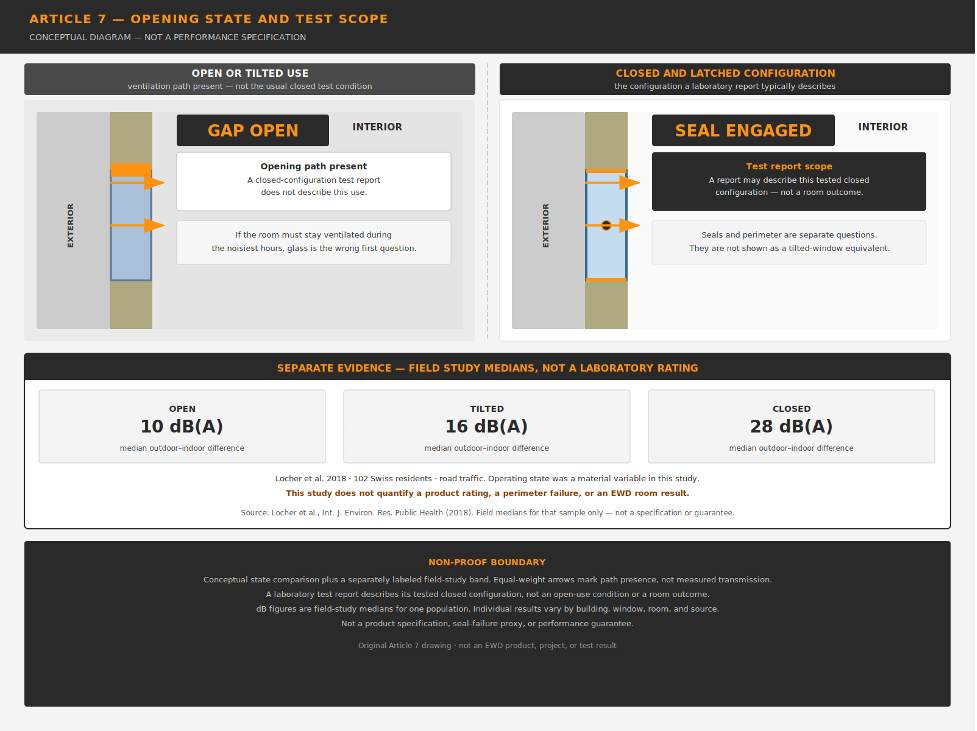
A laboratory test report describes a tested closed configuration. It does not describe open use, a perimeter defect, or what a specific room will hear.
Non-proof boundary: Conceptual only. Equal-weight arrows mark path presence, not measured transmission. Field medians are from one study population and are not a product specification or performance guarantee.
A window’s STC or OITC rating, when reported, is a measured classification of that unit’s laboratory sound transmission loss in a defined test configuration. That is what it is: evidence about a specific specimen under controlled conditions.
It is not a statement about how much quieter a room will be after installation.
Moving from a laboratory rating to a room result involves variables the rating does not hold constant: source spectrum, installation perimeter, frame and seal condition, other envelope paths, ventilation, and the room’s volume and surfaces. ASTM E90 itself states that laboratory ratings do not relate directly to sound isolation in buildings.
The FAA’s guidance on residential sound insulation treats windows, doors, roofs, walls, floors, and ventilation systems as components of a whole-building sound-insulation program rather than as independent items that can be upgraded and summed to a desired outcome. [FAA AC 150/5000-9A — Guidelines for the Sound Insulation of Residences Exposed to Aircraft Operations, 1993] The guidance addresses window-to-wall area ratios, door and foyer configurations, and ceiling-roof-space ventilation alongside glazing selection.
What this means in practice: a window’s acoustic rating is useful information for specifying a candidate unit. It is not sufficient information for predicting a room outcome. Installation, sealing, and surrounding construction may affect whether a tested potential is observed on site. That effect has to be investigated for the project; it is not a universal causal rule.
The frame of a window unit is not acoustically neutral. It has its own transmission characteristics, and the junction between the frame and the wall opening — the installation perimeter — is a distinct possible sound path, separate from the path through the glass.
A frame-to-wall junction with an air gap, missing backing, or sealant that did not bond to both surfaces is a potential parallel path that does not pass through the glass. Whether that path matters in a given opening requires investigation of that opening.
Acoustically demanding work — residential programs adjacent to airports, for example — often specifies installation detail as well as glass type: perimeter treatment, backer material, sealant, and sometimes secondary lining. The glass rating is one input. The installation condition is another.
For a residential replacement project, the practical implication is: if the goal is to improve what the room hears, the frame and the installation perimeter deserve attention alongside the glass specification. A high-rated unit with degraded compression seals or an open perimeter gap is a configuration question, not a predicted comparison against a mid-rated unit.
Even a well-specified and carefully installed window does not own all of a room’s sound exposure. Sound can also arrive through adjacent wall sections, the ceiling and roof, doors, and ventilation openings such as trickle vents, whole-house fans, or outdoor-adjacent returns.
The FHWA Audible Landscape describes acoustical construction as the treatment of walls, windows, doors, ceilings, and floors together — not windows alone. That is a grouping principle. It does not establish that the weakest component governs a room, and it does not identify which path is active in a house.
This flanking reality is not a reason to avoid upgrading a window. It is a reason not to treat the window as the whole problem before other possible paths are looked at. A close-window listening check cannot decide that the window is, or is not, the path that matters.
The useful homeowner observation is simpler: close the existing window as securely as possible and notice whether what you hear changes. A large change, or almost no change, may indicate that broader investigation is warranted. It cannot identify, rank, or exclude a transmission path.
| Item to document | Why it matters |
| Source type and spectrum | Road traffic, aircraft, and mechanical equipment have different frequency characteristics; candidate glass configurations should be checked against the actual source, not assumed. |
| Window operating state during loud conditions | If the unit is open or tilted when the noise is worst, a quieter closed unit does not change that exposure. |
| Frame and seal condition | Degraded compression seals and weatherstrip gaps are potential paths that bypass the glass. They need inspection; they are not a predicted room result. |
| Installation perimeter condition | Air gaps at the frame-to-wall junction are potential transmission paths. Record whether the perimeter appears sealed, partly sealed, or open. |
| Adjacent envelope elements | Record what the window shares wall space with — other openings, a ventilated soffit, doors, or lightweight construction — as items for investigation. |
| Room with window closed | A subjective note about whether closing the window changes what you hear is screening only. It does not identify, rank, or exclude a path. |
This is evidence that an acoustical professional or an experienced installer can use to decide whether further investigation is warranted. It is not a design specification, and it does not substitute for a test report on the specific configuration or for qualified review when a defined performance target is required.
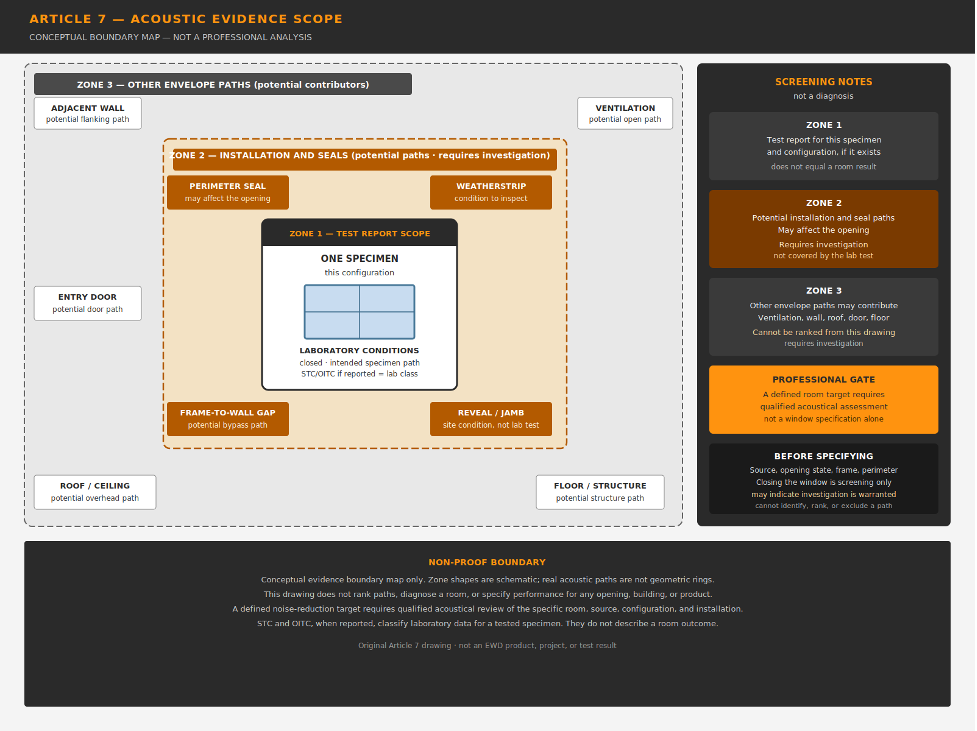
A window test report covers the inner zone — one specimen under laboratory conditions. Installation quality and other envelope paths occupy zones the report does not address and require investigation.
Non-proof boundary: Conceptual boundary map only; does not constitute a professional acoustic analysis, path ranking, performance specification, or recommendation for any specific opening, room, or building.
This article is a good fit if: The room has a specific outdoor noise source — a road, a transit line, an airport approach path, or a mechanical installation — that is noticeable when the window is closed. The current glazing is single-pane or early-generation insulated glass with no acoustic interlayer. The frame, seals, and perimeter appear intact enough to inspect, and the surrounding construction is not obviously an open ventilation path. In that situation, gathering exact-configuration acoustic evidence for a candidate opening assembly is a reasonable next conversation. It is not a predicted room result.
This article is a poor fit if: The noise is loudest when the window is open for ventilation, and the intended use of the room requires the window to be open. Upgrading the glass does not change exposure during open operation. Also a poor fit: the close-window screening observation changes very little, or photographs show an obviously open ventilation path, hollow-core door, or incomplete envelope — those are reasons to widen investigation, not to conclude which path governs.
Not the next step yet: The goal is a defined room performance level. A defined target requires an acoustical assessment of the specific room, source, and building configuration; exact test data on the candidate unit and configuration; a qualified acoustical professional; and a scope that accounts for installation detail, other envelope paths, and the complete assembly. No article substitutes for that work.
The most useful starting point is not a glass specification. It is a clear account of the source, the room, the opening state when the noise is worst, and what you notice when the existing window is closed as tightly as it can be.
If closing the current window changes what you hear, the window assembly is one item to investigate. If closing the window changes very little, broader investigation is warranted. Neither observation identifies, ranks, or excludes a path.
Bring photographs of the opening — frame condition, seal compression, perimeter treatment, and adjacent wall sections. Note whether a ventilation opening is present. Describe the source: steady road noise, intermittent aircraft, or a mechanical installation each present different frequency questions.
That record is what allows a conversation to be scoped — whether it leads to a glass question, a combined frame and glass question, a perimeter question, a ventilation question, or a qualified acoustical review before any product is ordered. CTA destination and service scope remain PENDING_OWNER.
Bring photographs of the opening, frame, and surrounding assembly, a description of the source and its times, what you notice with the window tightly closed, and any existing test reports or acoustic specifications to the project conversation.


 (310) 200 3931