
The kitchen glass is wet before the kettle boils. Beads sit on the room side of the pane. The sill is dark in a thin line. Last night was cool. Someone cooked. The first sentence in the house is already a verdict: the windows failed.
That sentence is faster than the evidence.
Water at an opening is a clue. It is not, by itself, a product finding, an installation finding, a rain-entry finding, or a reason to order a replacement. The useful next step is smaller: record where the water sits, when it appears, and whether the pattern repeats — then decide whose qualified look the record actually supports.
The short answer: Location, timing, and pattern change the next observation or qualified assessment. They do not name the water source, assign responsibility, or select a product or scope. Observation is not diagnosis.
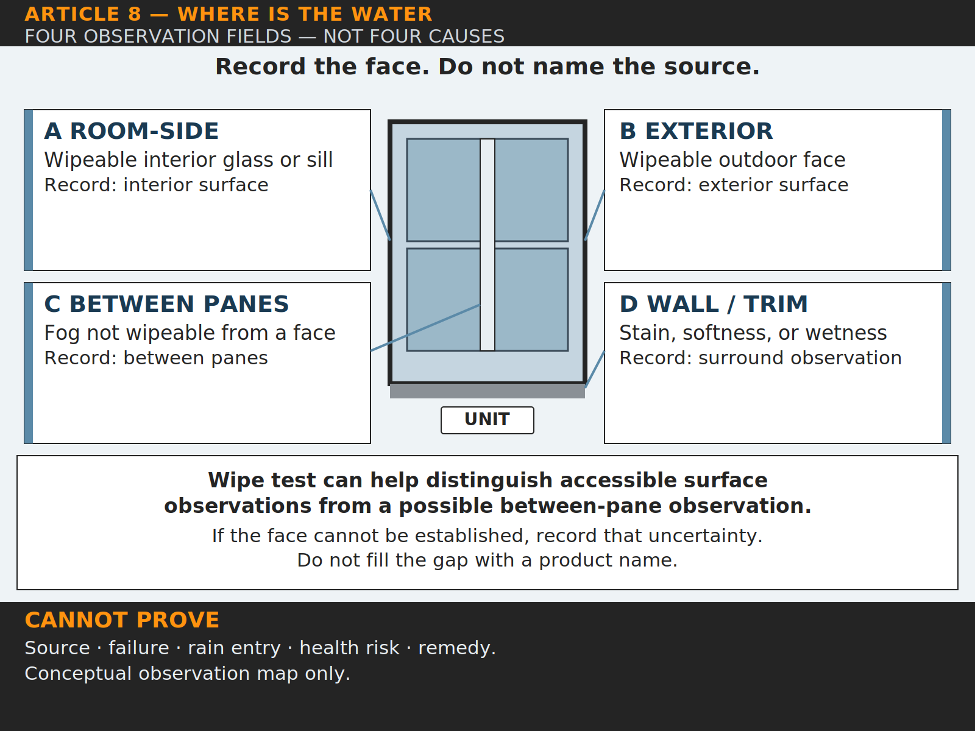
Record which face of the glass, and whether the water can be wiped, before anyone names a cause.
Non-proof boundary: Conceptual observation map only; does not identify a water source, product or installation failure, rain entry, structural condition, health risk, or remedy.
Start with the wipe test, then the surround.
Room-side glass or sill. Water that you can wipe from the interior face of the glass, or that collects on the interior sill, is an interior-surface observation. It is not a finding that the unit failed, that indoor humidity is “too high,” or that a new window will stop it.
Exterior glass. Water on the outdoor face that you can wipe, or that clears as the sun reaches the pane, is an exterior-surface observation. It is not proof that the window is working well, and it is not proof that it is not.
Between the panes. Fog, film, or droplets that sit in the cavity of an insulating-glass unit and cannot be wiped from either face is a different observation. ENERGY STAR lists cloudiness or moisture between the panes of double-pane windows among conditions that may prompt a replacement discussion, and it ties that listing to failed seals as a possible explanation. [Is It Time to Replace Your Windows? — ENERGY STAR, 2024] That listing is not a diagnosis of this opening. Whether a particular insulating-glass unit has a failed seal, lost gas fill, or a warranty condition is a manufacturer and product-record question.
Adjacent wall, trim, or finish. Staining, softness, or recurring wetness on the surround is an envelope observation. It does not, from a photograph, identify rain entry, condensation runoff, or a concealed wall condition. Scope questions about what a replacement path can and cannot expose belong on a separate planning page, not here.
If you cannot tell which of those four you are looking at, that uncertainty is itself the record. Do not fill it with a product name.
The National Weather Service defines dew point as the temperature to which air must be cooled, at constant pressure, to reach 100 percent relative humidity. Cool the air further and water vapor leaves the gas form as liquid. [Dew Point vs Humidity — National Weather Service]
ENERGY STAR’s Building Science introduction states that condensation forms when air with a high relative humidity — indoors or outdoors — contacts a surface below the dew-point temperature. [ENERGY STAR Qualified Homes, Building Science Introduction]
A U.S. Department of Energy–sponsored Pacific Northwest National Laboratory study of window attachments states the same mechanism for windows: condensation occurs when the surface temperature of a window component drops below the dew point or frost point of the air next to that surface. [PNNL-33380, Evaluation of the Thermal and Moisture Performance of Insulating Shades, 2022]
That is the physical threshold. It is not a room diagnosis.
It does not tell you whether this kitchen’s indoor moisture, this pane’s surface temperature, last night’s outdoor dew, an attached shade, or some other condition crossed that threshold. PNNL-33380 itself notes that when interior condensation appears, multiple factors are often involved, including window performance and indoor humidity, and that local climate and HVAC operation complicate any single-factor reading. This article does not prescribe a humidity target, a shade setting, a ventilation change, or a replacement.
A condensation-resistance number on a label, when one is reported, is rating evidence under defined conditions. Elite Windows & Doors’ energy-ratings page already owns how to read U-factor, SHGC, air leakage, and condensation-resistance fields, and it notes that condensation is not ruled out by a rating. [California Window Energy Ratings] This page does not re-teach those numbers. It only needs the limit: a rating is not an observation of this opening, and an observation is not a rating.
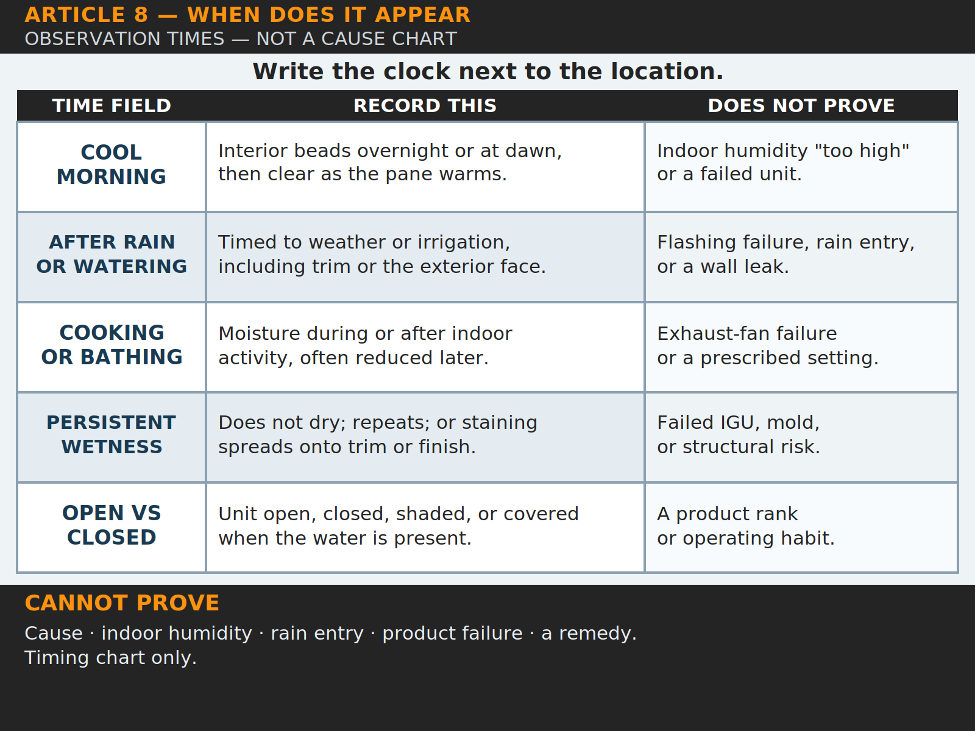
When the water appears is a second observation — it is not a diagnosis of humidity, rain, or a failed unit.
Non-proof boundary: Conceptual timing chart only; does not establish cause, indoor humidity, rain entry, product failure, or a remedy for any opening.
Write the clock next to the location.
A cool morning with interior beads that clear after the room warms is a different record from water that appears during a rain or irrigation event. Moisture that shows during cooking or bathing is a different record from wetness that never dries. Water that appears only when the unit is closed is a different record from water that appears while it is open.
None of those pairings names a cause. A morning pattern does not prove indoor humidity. A rain-timed pattern does not prove a flashing failure. A cooking-timed pattern does not prove that the range hood is inadequate. A persistent pattern does not prove a failed insulating-glass unit. Those are qualified-assessment questions.
Coastal exposure — salt, wind-driven rain, marine humidity — is a different page job. Use the coastal buyer guide for exposure questions; do not treat this triage page as an exposure or finish specification. [Southern California Coastal Windows & Doors]
After location and timing, record the pattern.
One opening, one cool morning, interior beads that wipe away: that is a bounded observation. Several openings on the same elevation doing the same thing on the same morning: still an observation, now of extent. The same opening, week after week, with staining that spreads onto trim: still not a diagnosis, but a reason to stop shopping for glass and start a qualified envelope or indoor-air conversation.
Between-pane cloudiness that never clears is not the same pattern as room-side beads that come and go. Do not average them into “the windows are sweating.”
Photographs help only if they show the face, the wipe, the clock, and the weather. A close crop of droplets proves droplets.
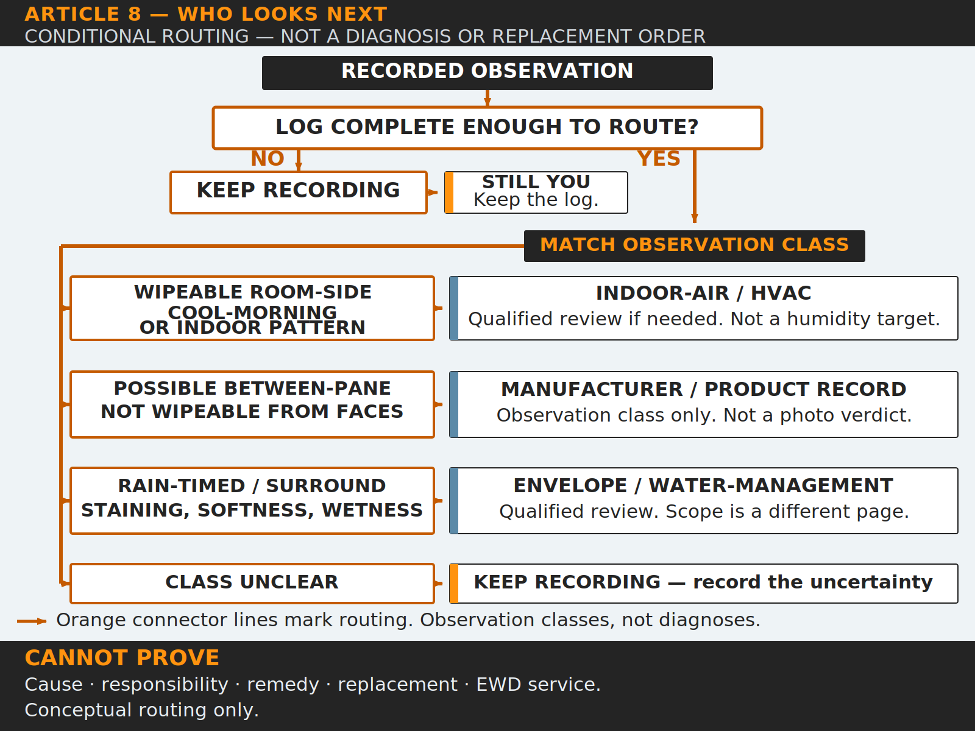
Location and timing change who should look next. They do not name the water source or the remedy.
Non-proof boundary: Conceptual routing map only; does not diagnose cause, assign responsibility, prescribe ventilation, sealing, or replacement, or define EWD service scope.
If the record is interior-surface water that appears with indoor activity or on cool mornings and wipes away, the next look — if one is needed — is a qualified indoor-air, humidity, or HVAC review, not a glass catalog. This article does not set a humidity target and does not tell you to run a fan.
If the record is moisture that cannot be wiped because it sits between panes, the next look is the product record: unit identification, date, warranty terms, and the manufacturer’s insulating-glass guidance. ENERGY STAR’s replacement-discussion listing is not a substitute for that record.
If the record is rain-timed water, staining, softness, or wetness on the surround, the next look is a qualified envelope or water-management review. Replacing the visible unit can leave the surround unanswered. That scope question is not this page’s job.
If the record is thin — one photograph, no clock, no wipe test — the next owner is still you. Keep recording.
Cause, remedy, responsibility, mold, health, and structural conclusions are outside this page. They require the actual opening, the actual indoor conditions, and the relevant qualified reviewer.
| Item to record | Why it changes the next step |
| Which of the four locations | Room-side, exterior, between panes, and surround are different observations; mixing them produces a false verdict. |
| Wipe test | Water you can remove from a face is not the same observation as water trapped between panes. |
| Time of day and indoor activity | Cooking, bathing, overnight cooling, and empty-house periods are context, not causes. |
| Weather and irrigation | Rain, fog, irrigation, and a dry cool morning are different timing fields. |
| Opening state | Open, closed, shaded, or covered changes the surface the air meets; it does not rank a product. |
| How many openings, how often | Extent and repetition change whether the next step is more recording or a qualified look. |
| Photographs of face, sill, and surround | A crop of droplets does not show location; include a reference to the room and the exterior when possible. |
This list is an observation log. It is not a bid form, a moisture survey, or a diagnosis.
Good fit: You can see water, fogging, or staining at or near an opening and you are about to treat replacement as the only answer. This page is for pausing long enough to separate location, timing, and pattern.
Poor fit: You already have a qualified envelope, HVAC, or manufacturer finding, or you need a product, rating, coastal-exposure, or replacement-scope decision. Those jobs live on other pages.
Stop: Visible decay, repeated interior wetting of finishes, suspected rain entry, or any indoor-air or health concern. This article will not interpret those. Route them to the appropriate qualified reviewer.
The editorial thought ends here. A useful next conversation starts with the log, not with a catalog.
Bring photographs that show which face of the glass is wet, whether the water wipes, the time and weather, the opening state, and any staining on the surround to the next project conversation.


 (310) 200 3931