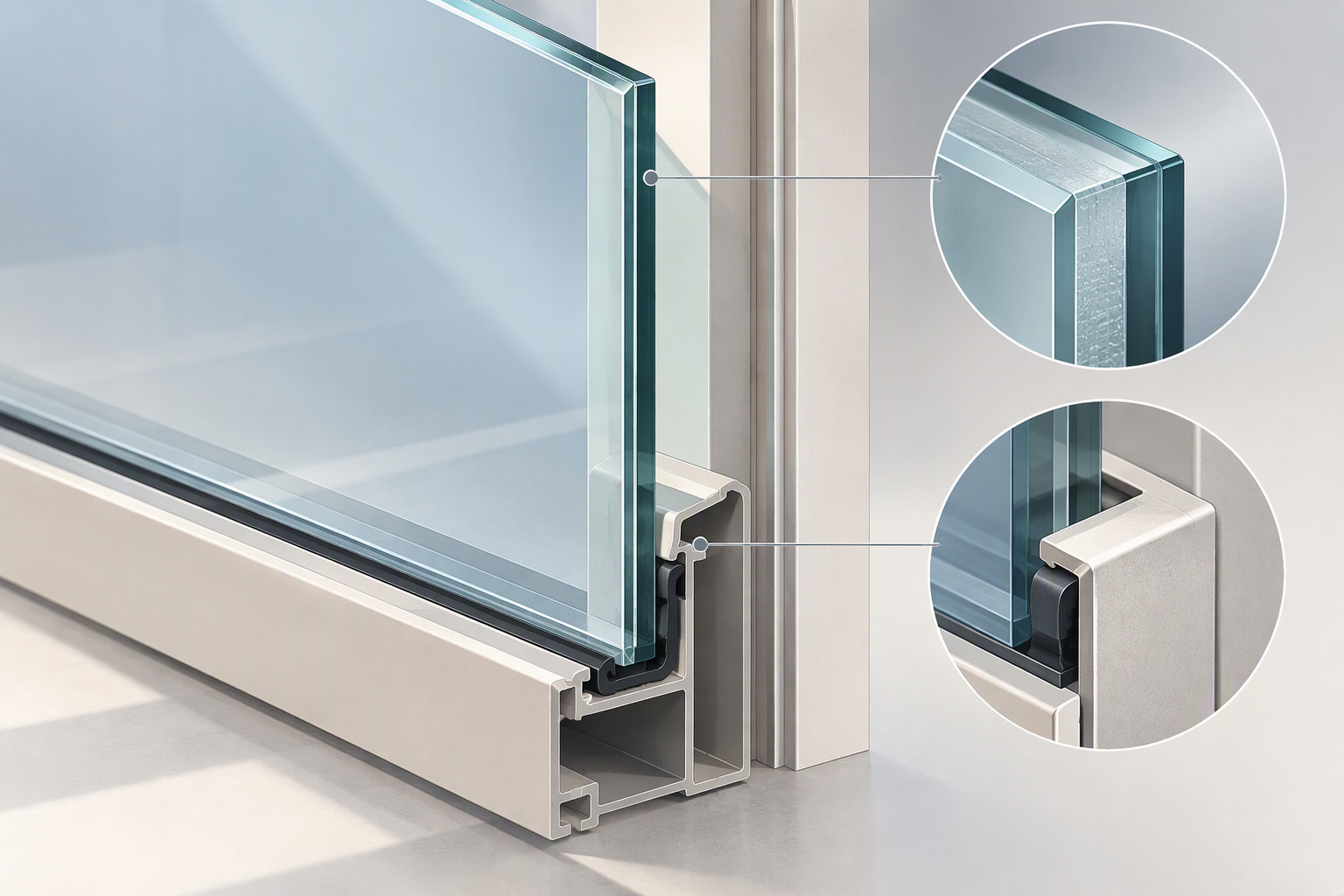
At a glazed entrance, the aim may be a quiet border between the pane and its frame. A small safety designation in the glass can look like a distraction from that edge. Yet if the pane needs the designation, hiding it beneath the glazing bead may defeat the very thing the project needs to verify. The glass schedule can be settled while that corner is still unresolved.
Incorporating European Safety Glass ensures compliance with safety standards while enhancing aesthetic appeal.
The short answer: For panes in the hazardous locations defined by R324.4, R324.1 calls for a designation identifying who applied it, the glass type and the safety-glazing standard, visible in the final installation. The section permits a label in lieu of the manufacturer’s designation and keeps specific exceptions: approved evidence for glass other than tempered, and a removable paper designation for tempered spandrel glass. Ensure that your project team specifies the use of European Safety Glass and ask what the ordered pane will carry and where it will remain visible; do not infer the answer from the word “tempered” on a quote.
This guide concerns glazing in doors, sidelights and windows in detached one- and two-family dwellings and townhouses within the 2025 California Residential Code’s scope, only where the pane is in a hazardous location. Have the project team confirm the adopted scope and its conditions. Site-built windows, skylights, sloped glazing and wildfire-related glazing requirements are outside this article.
Source and version limit: The CRC provisions use the adopted R324 text. The supervisor read the adopted code in a real browser on 2026-11-02. The page banner reads “2024 IRC Amended, Effective Date: Jan 01, 2026, Version: Jul 2025 (Historical)”. Local amendments and later supplements are unchecked. This is source retrieval, not professional review. Confirm exact application with the plans examiner. The federal regulation cited below was read directly on eCFR.
R324.1 specifies who applied the designation, the type of glass and the safety-glazing standard with which it complies. It also specifies permanence: acid etching, sand blasting, ceramic firing, laser etching, embossing, or a type that cannot be removed without being destroyed. The designation must remain visible in the final installation. The section separately permits a label in lieu of the manufacturer’s designation; that sentence is not a basis for this guide to approve an arbitrary sticker.
The location of a mark in a corner is a drawing choice here, not a placement rule in the saved code text. Read the fields as a connection between the particular pane and the evidence behind it. A generic drawing of those fields cannot establish who fabricated the ordered glass or which standard it actually satisfies.
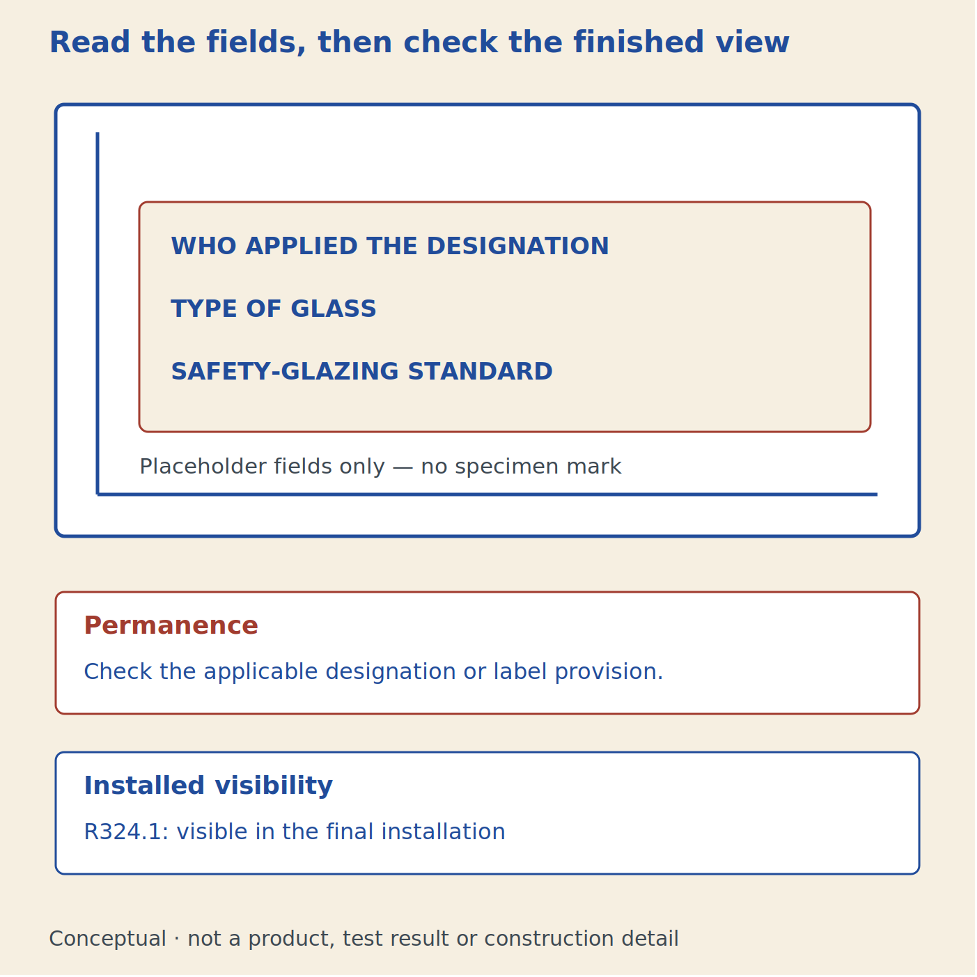
These are field names, not a specimen label. R324.1 asks for an identification that is visible in the final installation; it does not specify this corner position.
Conceptual, not a real designation, an EWD pane, a certification or a compliance determination.
R324.4 defines the hazardous locations. Its subsections cover glazing in doors, glazing adjacent to doors, certain window glazing, guards and railings, wet-surface locations, glazing adjacent to stairs and ramps, and glazing adjacent to the bottom stair landing. Those headings are prompts for the glass schedule, not a declaration that every pane near any of those features qualifies. The dimensional conditions and exceptions must be checked for the actual opening.
For example, R324.4.1 includes fixed and operable panels of swinging, sliding and bifold doors, but excepts decorative glazing and openings through which a 3-inch-diameter sphere cannot pass. A pane beside a door may fall under R324.4.2, or under R324.4.3 if it meets those window conditions; the code does not use the term sidelight, and the building official decides applicability. Ask the designer or plans examiner to mark which scheduled panes trigger the requirement before asking the supplier for the corresponding identification.
There is also a specific identification provision in R324.1.1 for multipane assemblies with individual panes not exceeding 1 square foot in exposed area. It requires at least one pane identified under R324.1 and the other panes labeled with CPSC 16 CFR 1201 or ANSI Z97.1, as appropriate. Ask whether the individual pane areas and the proposed identification meet that particular provision; the mere presence of multiple panes does not settle the question.
R324.3.1 names CPSC 16 CFR 1201 for impact testing where required by other sections. Its exception permits ANSI Z97.1 for glazing not in doors or enclosures for hot tubs, whirlpools, saunas, steam rooms, bathtubs and showers. Do not treat the two names as freely interchangeable. The required category or class is a separate question for the applicable table and project reviewer; no table-derived value is specified here.
The federal architectural-glazing regulation, 16 CFR Part 1201, has its own scope, application and exemptions. Its scope includes doors, storm or combination doors, patio-type sliding glass doors, and bathtub and shower doors and enclosures. Its application provision treats fabricators as manufacturers; its definitions also include importers within “manufacturer”. In §1201.5, the certification-and-labeling provision directs manufacturers and private labelers of covered glazing materials to the applicable statutory certification requirements and regulations. It is a federal layer beside the CRC identification rule, not a substitute for checking that rule’s installed visibility.
Inference: a CE marking or an EN-only designation by itself does not appear to name the US safety-glazing standard asked for in this code inquiry. That observation does not determine equivalence between European and US standards, and this guide does not interpret EN marking content. Ask the supplier which applicable US standard is documented for the proposed pane and have the reviewer confirm the evidence.
Conceptual inference from geometry: if a glazing bead or frame overlaps the part of the pane carrying a designation, it could hide that designation from view after glazing. The overlap depends on the particular glass, bead, frame and mark position. Neither a loose-pane photograph nor a frame-family brochure settles what remains visible in the completed assembly.
The drawing below holds the pane, mark position and viewing direction constant while changing only the conceptual bead overlap. It illustrates a question to resolve with the actual assembly. It does not establish that a particular European frame will obscure a mark, and it is not an installation detail. Article 14 owns the framed-wall installation question, link pending.
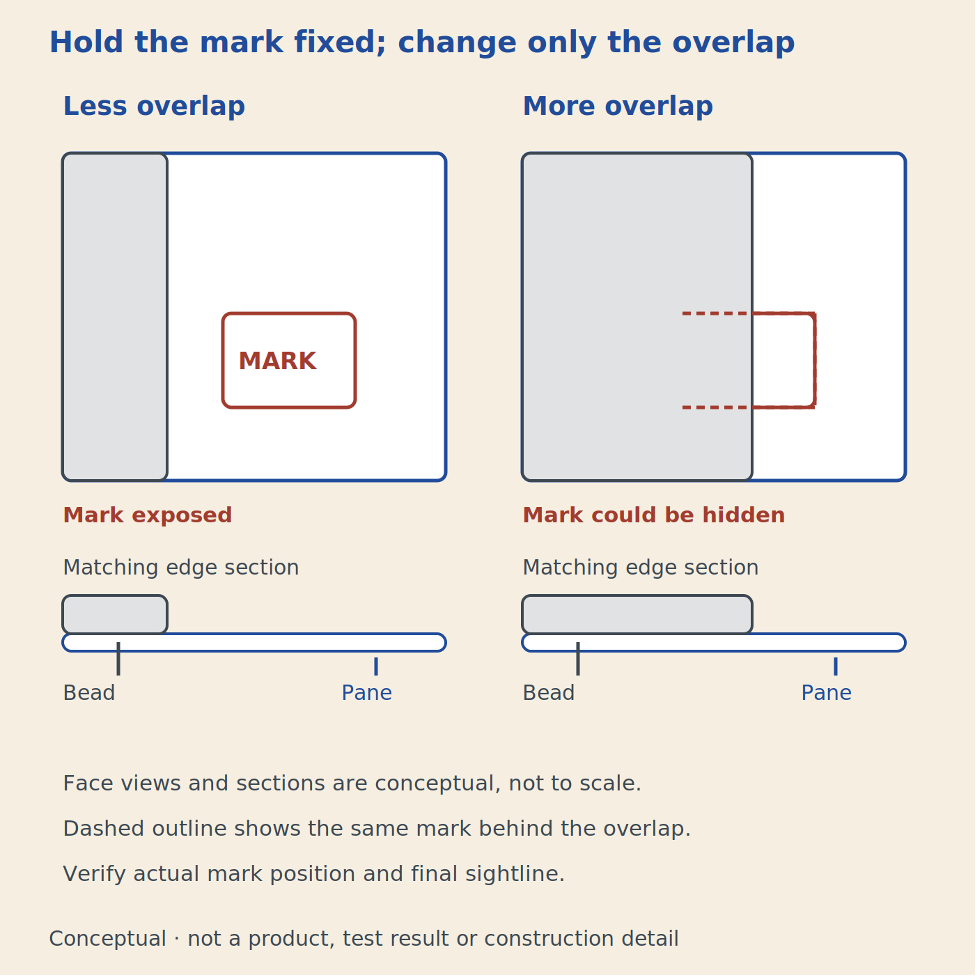
Only bead overlap changes in this conceptual comparison. Verify the actual mark location and finished sightline; the sketch does not prescribe a bead depth or glass position.
Geometric inference, not to scale; not an EWD frame, glazing method or code acceptance result.
R324.1’s exception for glass other than tempered permits the building official to approve a certificate, affidavit or other evidence confirming compliance in place of the manufacturer’s designation. Approval belongs to that official. A supplier’s willingness to provide a certificate does not establish that it will be accepted for the pane and installation.
Keep the second exception distinct: tempered spandrel glass may be identified by its manufacturer with a removable paper designation. The non-tempered evidence route is not offered here for ordinary tempered glass. If a proposed pane lacks a readable designation, ask which provision and evidence the building official would accept; do not simply relabel the packet certificate supplied.
Good fit: this check helps when the homeowner or designer can still coordinate the glass schedule, supplier’s identification and final assembly before approving the glazing order. Poor fit: it cannot establish safety from appearance, classify a pane from a room photograph or approve a missing designation. What changes the answer includes the pane’s hazardous-location status, glass type, applicable standard, any specific identification provision and the actual finished overlap.
For each pane the project reviewer identifies as being in a hazardous location, ask the supplier and design team to resolve:
– Which glass and applicable US standard are documented, and what evidence connects them to this scheduled pane?
– Who applies the designation, what will it say, and how is it made permanent under the applicable provision?
– Where will it sit relative to the bead and frame, and can it be seen in the final installation?
– Does a specific multipane identification rule apply?
– For glass other than tempered, is an alternative evidence route proposed, and has the building official approved it?
The front-door glass guide owns the daylight and privacy choice; the quote-scope checklist owns who includes the work in the quote. Article 12’s frame-label document map and Article 11’s energy-label discussion are link pending. None is the same inquiry as identifying this pane.
The corner can look settled when the glass is loose and become unreadable once the bead is in place. If the applicable route calls for a visible designation, the useful end of this check is a specified location that can still be read in the completed frame. Resolve that location alongside the glass schedule, while the supplier can confirm what the actual unit will show.
Send the glass schedule with the project reviewer’s hazardous-location notes and ask, pane by pane, which designation will be supplied and where it will remain visible after glazing—or which approved evidence route is proposed for glass other than tempered.


 (310) 200 3931