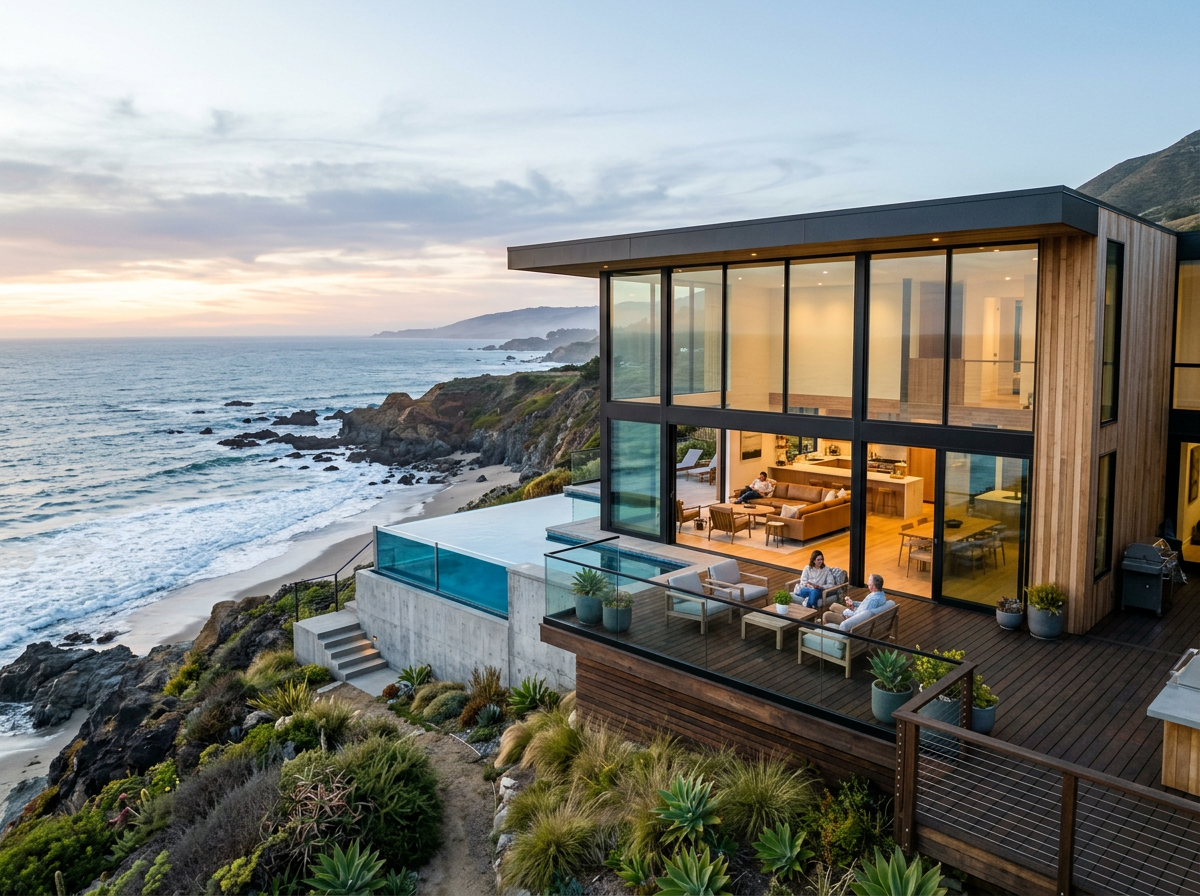
Living near the Southern California coast changes the questions you should ask about windows and doors. Salt deposits, intense sun, wind-driven rain, humidity, large openings, and marine-facing elevations can place different demands on products and installation details.
That does not mean every home near the ocean needs the same material, glass package, or hardware. A sheltered home several blocks inland and an exposed bluff home may face very different conditions. The useful question is not, “What is the best coastal window?” It is:
What exact product, configuration, finish, hardware, glazing, installation method, maintenance plan, and warranty fit this home’s exposure and design?
This guide shows you how to compare the evidence behind that answer.
Distance from the ocean is only one clue. Before comparing products, document the conditions at each elevation and important opening:
Record those observations by elevation. A project may need different glass, hardware, finish, or operating choices on the ocean-facing side than on a sheltered courtyard.
Do not diagnose the source of existing water damage from a stain alone. Water can travel through roofing, cladding, wall penetrations, flashing, plumbing, or the opening itself. If damage is visible, the responsible project team should investigate the surrounding assembly before assuming a new window will solve it.
Vinyl, aluminum, fiberglass, wood, clad products, and composite systems can all differ significantly within their categories. Material names alone do not tell you the tested performance, finish durability, frame reinforcement, hardware, drainage design, sightlines, maintenance requirements, or warranty of the proposed unit.
For every serious option, ask for the exact:
Words such as “marine grade,” “coastal package,” “lifetime,” or “maintenance free” are not substitutes for those documents. If a special coastal option is proposed, ask what components it changes and how the warranty treats the project’s actual distance and exposure to salt water.
Homeowners often see several labels and assume they measure the same thing. They do not.
The National Fenestration Rating Council provides independent, third-party certification for energy performance. Its label can report U-factor, solar heat gain coefficient, visible transmittance, air leakage, and condensation performance. These numbers help compare the exact proposed product and glass configuration.
NFRC ratings do not by themselves answer how the product handles wind-driven rain, structural loads, coastal finish exposure, or the quality of the field installation.
The North American Fenestration Standard guidance summarized by FGIA addresses product performance categories including air leakage, water penetration, structural strength, and forced entry. Ask which standard, class, performance grade, size, configuration, and test report apply to the proposed unit.
FGIA also draws an important boundary: a certification label applies to the product as it leaves the factory. It does not certify the installed assembly. The opening, anchors, flashing, sealants, interfaces, and field workmanship still matter.
The responsible contractor, designer, engineer, energy consultant, and building department determine what applies to the exact address and scope. Wind exposure, safety glazing, emergency escape, structural changes, energy compliance, fire conditions, waterproofing, and permitting can involve different rules.
Do not turn a product brochure into a project-specific code conclusion. Ask who is responsible for confirming each requirement and documenting it before the order is released.
A window or door is installed into a wall. Water control therefore depends on more than the product’s factory test.
PNNL Building America guidance describes a drainage approach that directs water down and out. Sill flashing, jamb and head flashing, the water-resistive barrier, pan or drainage path, cladding, sealants, and penetrations must work together. FEMA’s coastal installation guidance similarly warns against relying on sealant alone.
Before approving the quote, ask the proposer to identify in writing:
A low quote that names only the window and caulk is not a complete waterproofing scope.
Southern California does not have one universal glass target. California has 16 climate zones, and the applicable energy requirement depends on the project address, permit date, scope, and compliance path. The 2025 Energy Code applies to permit applications submitted on or after January 1, 2026. Orientation and exterior shading also change how an opening behaves.
Use the NFRC label to compare:
The lowest number is not automatically best for every metric. A west-facing room with severe afternoon sun, a shaded north-facing opening, and a view wall may have different priorities. Exterior overhangs, shading devices, interior glare control, room use, and HVAC design can matter alongside the glass.
Ask for the NFRC information tied to the exact manufacturer, series, size, operator, frame, and glass package in the quote. Do not accept a label from a different configuration as proof for the proposed unit.
Oceanfront roads, aircraft paths, outdoor activity, and dense neighborhoods can make sound control important, but energy labels do not report sound performance.
If noise is a priority, describe the source and the rooms affected. Ask for sound-test data such as STC or OITC for the exact assembly when available, and confirm the test size and configuration. Laminated or asymmetric glazing, air spaces, frame design, seals, and installation airtightness can all affect performance.
Do not assume that triple-pane glass, a particular frame material, or one generic sound number guarantees the desired result. Low-frequency traffic or aircraft noise can behave differently from speech-frequency sound, and weak paths through walls, vents, roofs, doors, or installation gaps can limit the result.
Coastal exposure makes routine inspection and cleaning more important, but the correct procedure must come from the exact manufacturer and finish supplier. An internet rule such as “rinse twice a year” may be too frequent, too infrequent, or incompatible with the product.
Ask for written guidance covering:
Then read the warranty exclusions. Look for coastal-distance limits, finish or hardware exclusions, glass-edge and seal conditions, labor coverage, transfer rules, maintenance duties, registration requirements, and the party responsible for field service.
“Lifetime” is not a complete warranty description. The written terms control.
Give every bidder the same opening list and goals. For each proposal, confirm:
California’s Contractors State License Board guidance advises consumers to verify the license and obtain at least three written bids based on identical plans, specifications, and scope. Do that before using price as the final tie-breaker.
Large coastal openings often affect architecture, structure, waterproofing, interiors, exterior finishes, shading, privacy, furniture placement, and mechanical comfort at the same time. Bring the architect, designer, contractor, window or door supplier, installer, and appropriate consultants into the decision before final dimensions and finishes are locked.
Useful coordination documents include:
Early coordination is especially valuable for custom sizes, narrow sightlines, multi-panel doors, corner conditions, and openings that change structure or floor levels.
For a Southern California coastal home, the best choice is the documented system that fits the home’s real exposure, design, code context, maintenance capacity, and installation conditions.
Start with the opening and the wall, not a material ranking. Compare exact products and configurations. Separate energy ratings from air/water/structural evidence. Require a written installation and water-management scope. Read maintenance and warranty terms before ordering. Then compare bids on the same work.
Ready to make the project more concrete? Send Elite Windows & Doors the project ZIP, opening list, photographs, plans if available, and the main concerns for each elevation. The team can review the request and help identify the information needed for the next step.
Request a Project Consultation
Call (310) 200-3931 1
2573 Crenshaw Blvd, Hawthorne, CA 90250

We invite you to discover the difference and be pleasantly surprised by our pricing.
We serve all U.S. states
Free Delivery for all Customers in Orange County and Los Angeles County
Crenshaw Business Complex,
12573 Crenshaw Blvd Hawthorne, CA 90250

 (310) 200 3931