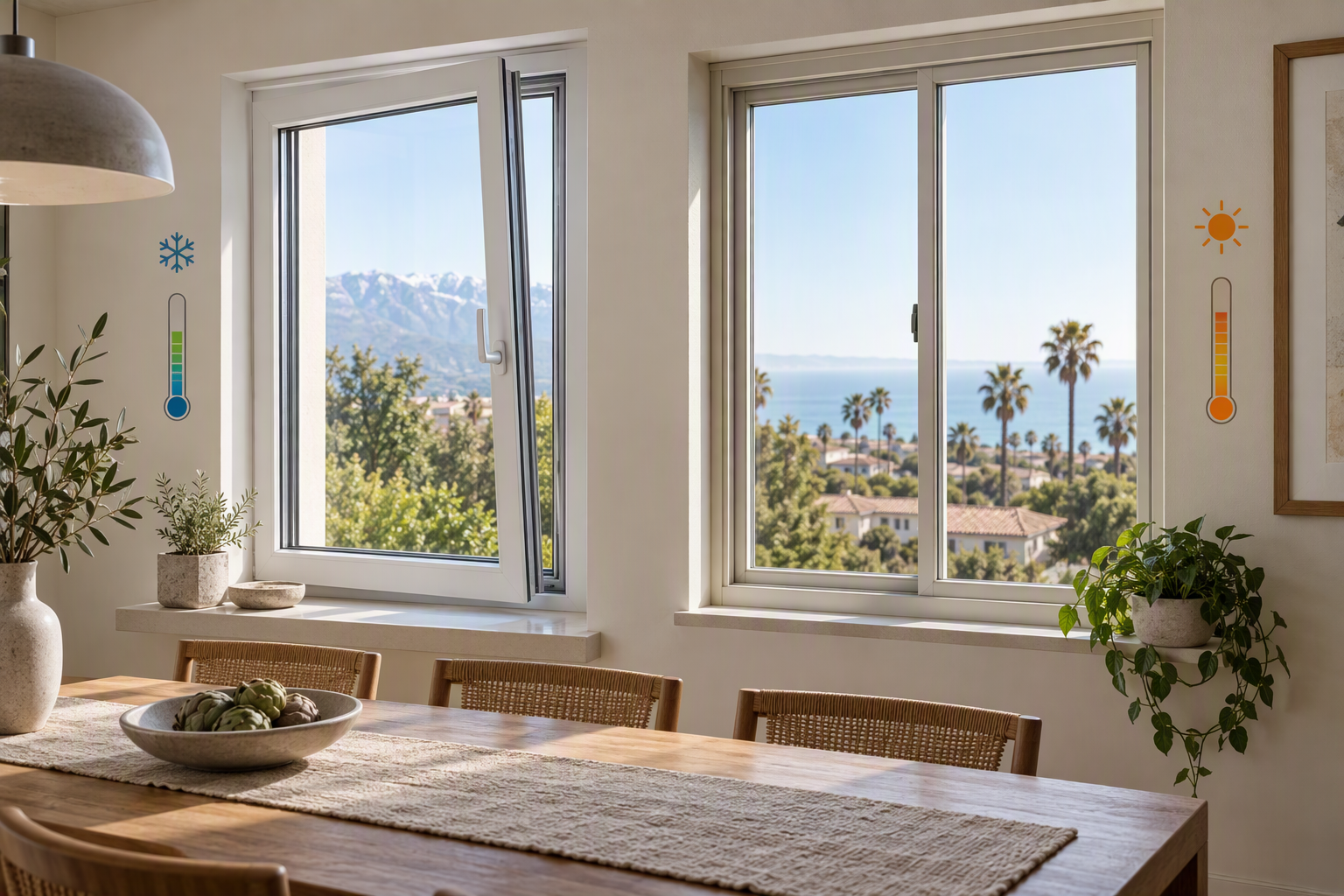
Two quotes lie side by side on a dining table, both for the same wall of windows. The European one is the one the owners want: deeper frames, three panes of glass, the proportions the architect drew. Its spec sheet gives a Uw in W/m²K and the phrase “Passive House-capable”. The American quote is plainer, and every line item points to an NFRC label. The owners would like to know which window loses less heat. The permit office will want to know something else first: which of these two numbers it is allowed to use. Understanding the European Window U-Value vs NFRC Label in California is essential for making an informed decision.
The short answer: Not by conversion. A European Uw and an NFRC U-factor are calculated under different rules, so changing W/m²K into Btu/(h·ft²·°F) changes the unit, not the test. Under the 2025 California Energy Code, a window’s U-factor must be rated under NFRC 100 or take the default value in Table 110.6-A, and for a single-family home the label the inspector sees can carry only one of those two. The defaults are high: the CEC’s own compliance manual says no product in the default tables meets the mandatory 0.40 maximum on its own. So the document that makes the two quotes comparable is an NFRC certification for the exact European configuration. Without one, have an energy-code consultant confirm the compliance path before either quote is signed. Knowing the European Window U-Value vs NFRC Label in California can guide this process.
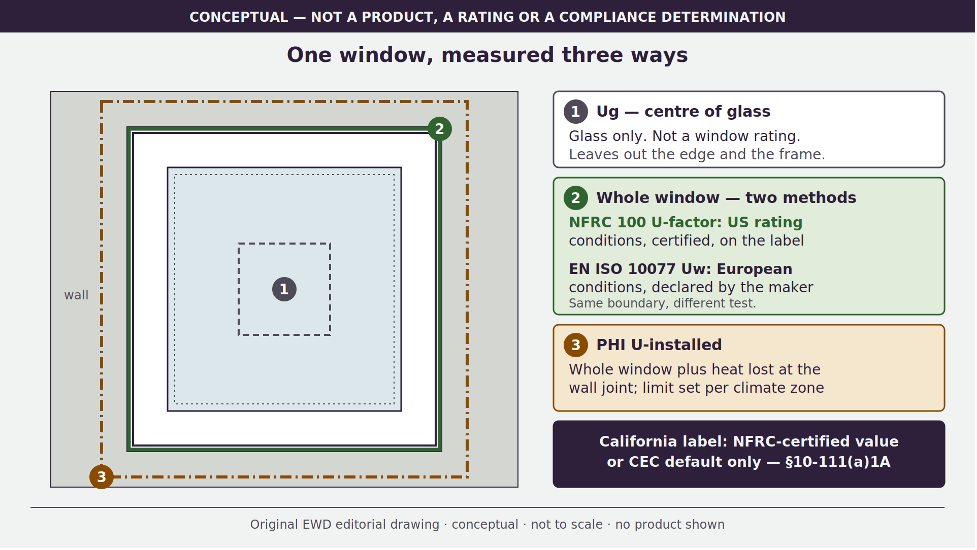
Same window, different boundaries and conditions. A glass-only Ug is not a window rating at all, and the Passive House installed figure also counts the wall joint.
Non-proof boundary: Conceptual drawing only; it is not an EWD product, a measured or rated window, or a determination that any product complies.
The useful comparison is not window against window. It is document against document, because each number on the table answers a different question. Reading U-factor and SHGC on an NFRC label is covered on our page How to Read Window Energy Ratings in California; this page starts where that one stops, with the window that arrives without one.
| Field | NFRC-certified label | European declared Uw | Passive House component certificate |
| What it measures | Whole product: glass, edge and frame | Whole window: glass, edge and frame | Whole window, plus a separate installed value that adds the wall joint |
| Method | NFRC 100 (U-factor) and NFRC 200 (SHGC), certified through an NFRC-licensed inspection agency | EN ISO 10077 calculation, declared by the maker | PHI criteria; the component value is calculated to DIN EN ISO 10077-1 |
| Conditions | North American rating conditions | European conditions | European calculation, judged against a limit for one climate zone |
| Unit printed | Btu/h·ft²·°F | W/m²K | W/m²K |
| May it go on the California temporary label? | Yes | No | No |
Two rows decide the matter. The method row explains why the numbers drift apart even for the same window. The last row, taken from Part 1 of Title 24, explains why the drift matters in California: §10-111(a)1A says the temporary label may carry no U-factor, SHGC, visible transmittance or air-leakage values other than NFRC-certified ones or the CEC defaults.
Changing W/m²K into Btu/h·ft²·°F is a fixed multiplication. The result still describes a European calculation. NFRC and the European method calculate the same glass and frame at different outdoor conditions, wind speed among them, and under different standards. A glass-industry writer from a spacer and thermal-break manufacturer shows the gap is large enough that the best width between the panes differs between the two methods (Technoform, Sanders, June 2026). That source explains the mechanism; it is not a rule and gives no correction factor for any product.
This page therefore gives no conversion table. A converted European figure placed beside an NFRC label looks like a like-for-like number. It is not one, and California will not accept it as one.
Two other numbers often sit on a European spec sheet. Ug is the centre of the glass only, and is not a window rating. The Passive House installed value goes the other way: it adds the heat lost where the frame meets the wall, so it describes the window in a particular installation, not the product on its own.
Section 110.6(a)2 of the 2025 California Energy Code (CEC-400-2025-010-F) is short. A fenestration product’s U-factor “shall be rated in accordance with NFRC 100, or use the applicable default U-factor set forth in Table 110.6-A”. Section 110.6(a)3 says the same of SHGC, with NFRC 200 and Table 110.6-B. A W/m²K declaration, an EN test report and a Passive House certificate are not named.
On a single-family job the evidence is the label itself. Every manufactured window must arrive with a temporary label, and that label “shall not be removed before inspection by the enforcement agency” (§110.6(a)5A). A rated window’s label carries NFRC-certified values. An unrated window’s label must read “CEC Default U-factor”, “CEC Default SHGC” and “CEC Default VT”, followed by the table values (§10-111(a)1B). The inspector compares that label with the values in the compliance documents. The separate certificate of acceptance in §110.6(a)6 applies to site-built fenestration in buildings other than single-family homes; it is not the single-family route.
Table 110.6-A gives defaults by frame and glazing. For double-pane products they include 0.58 for a nonmetal operable window, 0.55 for a nonmetal fixed window, 0.53 for a nonmetal glazed door, and 0.66 for an operable thermally broken metal window. Dividers between the panes with a spacer under 7/16 inch, or true divided lites, add 0.05.
Set those beside the limits in the same code:
| Limit | Value | Where it applies |
| Mandatory maximum, weighted average | 0.40 | New single-family homes, additions and alterations (§150.0(q)), with the exceptions below |
| Prescriptive maximum, area-weighted average | 0.27 in climate zones 1–5, 11–14 and 16; 0.30 in zones 6–10 and 15; a new dwelling of 500 sq ft or less in zone 5 may use 0.30 | Table 150.1-A and §150.1(c)3A, also used for added and replacement windows (§150.2(b)1A–B) |
| Small replacement exception (U-factor) | 0.40, with an SHGC of 0.35 or less in climate zones 2, 4 and 6–15 | Up to 75 sq ft of replacement vertical fenestration (§150.2(b)1B, Exception 1) |
Taken on its own, every double-pane default is above every one of those limits. The CEC states the first comparison itself: “No fenestration products in the default tables meet the mandatory maximum U-factor of 0.40 individually” (2025 Single-Family Residential Compliance Manual, ch. 3). But the limits are not applied to one product at a time. The prescriptive values are met as an area-weighted average of the installed fenestration (§150.1(c)3A), and the 0.40 cap is a weighted average too. So the reading has two parts. An unrated window carried at its default is above 0.27, 0.30 and 0.40 by itself, however good its European figure is. Whether a project that includes it can still comply depends on what it is averaged with, and that is the energy-code consultant’s calculation.
Which windows form the averaging set is itself part of that calculation. For an addition or an alteration, the consultant establishes which products are averaged; retained windows should not be assumed to offset replacement ones. §150.0(q) also exempts up to 10 sq ft or 0.5 percent of the conditioned floor area, whichever is greater, up to 30 sq ft of dual-glazed greenhouse or garden windows, and fenestration in buildings that meet the California Building Code’s wildland-urban interface provisions (Part 7) in a designated fire hazard area. The performance approach can trade a window that misses the prescriptive value against other features of the house, but it does not waive the mandatory cap (§150.2(b)2A keeps §150.0(q) on the performance path for alterations). Which of these, if any, rescues a particular unrated window is a calculation for an energy-code consultant on that project, not a conclusion this page can draw.
One more gap is worth asking about. Table 110.6-A has columns for single pane, double pane and glass block. It has no triple-pane column. How an unrated triple-glazed unit is entered is a question for the consultant, and the answer should be in writing before the order.
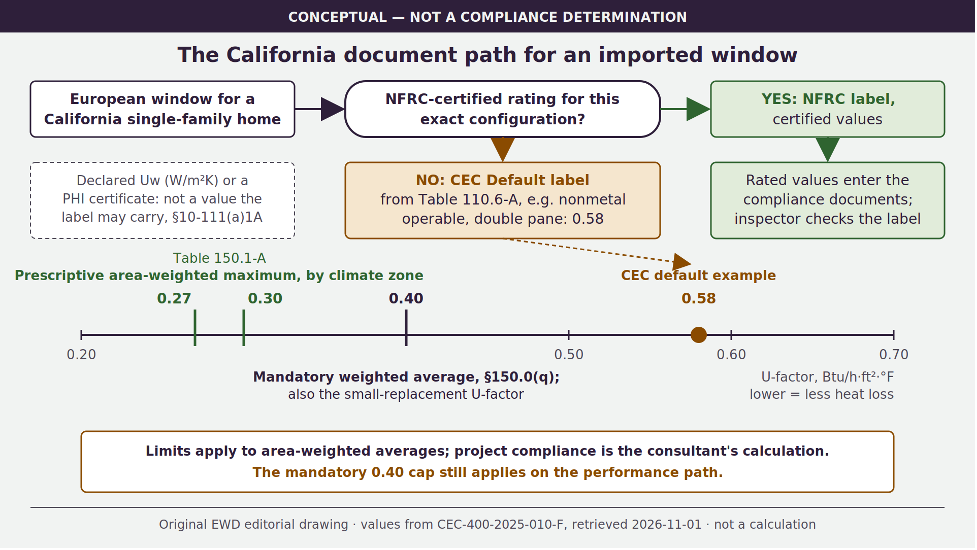
The path forks at one document. Lower U is better. Taken alone, the sample default sits above all three limits, and no double-pane default is at or below 0.40; the limits apply to area-weighted averages, so whether a project complies is the consultant’s calculation.
Non-proof boundary: Conceptual drawing only; it is not an EWD product, a compliance calculation, or a determination for any project.
“Passive House-capable” points to a third yardstick with its own logic. The Passive House Institute’s criteria for transparent components, version 5.6 of 1 April 2025, set limits by climate zone, both for the window on its own and for the window as installed (PHI criteria, v5.6). The installed limit is 0.85 W/m²K for the cool-temperate zone, 1.05 for warm-temperate and 1.25 for warm. PHI notes that the warm-temperate and warm criteria are in a trial phase, and that it currently issues certificates only for the arctic, cold, cool-temperate, warm-temperate and warm regions.
So 0.85 is not “the Passive House number”; it belongs to one climate zone. More to the point here, a PHI certificate is not one of the two sources §110.6 names. It can tell a designer how the window behaves in a carefully detailed wall. It does not replace the NFRC rating or the default value in a California compliance file, and a project pursuing both standards needs both kinds of document.
Good fit. A European window whose exact configuration (frame, glazing, spacer, operating type) is NFRC-certified, so the label values can go straight into the compliance documents and the comparison with the American quote is like for like. Also a project already using the performance approach with an energy-code consultant who has modelled the European unit at its actual rated or default values before the order.
Poor fit. An unrated import on a project that expects to use the prescriptive path without having checked the average, or one where the European unit is most of the glazing in the averaging set, so the average has little lower-U rated glass to lean on. Also a buying decision made on the strength of a converted W/m²K figure or a Passive House label alone.
What changes the answer. Whether the exact configuration is NFRC-certified; the climate zone; whether the work is a new home, an addition or an alteration; how much of the averaging set the unit represents; whether the building falls under the wildland-urban interface exception; whether the triple glazing has a recognised default; and what the consultant’s performance model shows.
Keep the general quote comparison on our page How to Compare Premium Door Quotes. For this question, the list is short and is only about rating documents.
| Ask for | Why it decides the comparison |
| The NFRC-certified U-factor and SHGC for the exact configuration, with the certification reference | Only these values, or the CEC defaults, can appear on the California label (§10-111(a)1). |
| If there is no NFRC rating, the exact “CEC Default” values the label will carry, and the Table 110.6-A row they come from | The default replaces the European figure in every California calculation. |
| Which compliance path the project will use, prescriptive or performance, confirmed by the project’s energy-code consultant | The prescriptive limits are 0.27 or 0.30 by climate zone, met as an area-weighted average; every double-pane default is above them on its own. |
| Which windows form the averaging set, how the mandatory 0.40 weighted average works out for them, or which exception applies | The performance path does not waive §150.0(q). |
| For triple glazing without an NFRC rating, how it will be entered | Table 110.6-A has no triple-pane column. |
| The declared Uw and any PHI certificate, kept as design information | Useful for comparing European products with each other; not accepted as the California value. |
This is a document list. It is not a compliance review, and the project’s energy-code consultant and building department decide what the file needs.
The European number may describe a very good window. In California the question is not how good the number is but which document stands behind it, and only one kind of document lets the two quotes on the table be read on the same scale.
Send us the exact configuration on the European quote, its NFRC certification reference if it has one, and the compliance path your energy consultant expects to use, and ask which document the order will ship with.


 (310) 200 3931