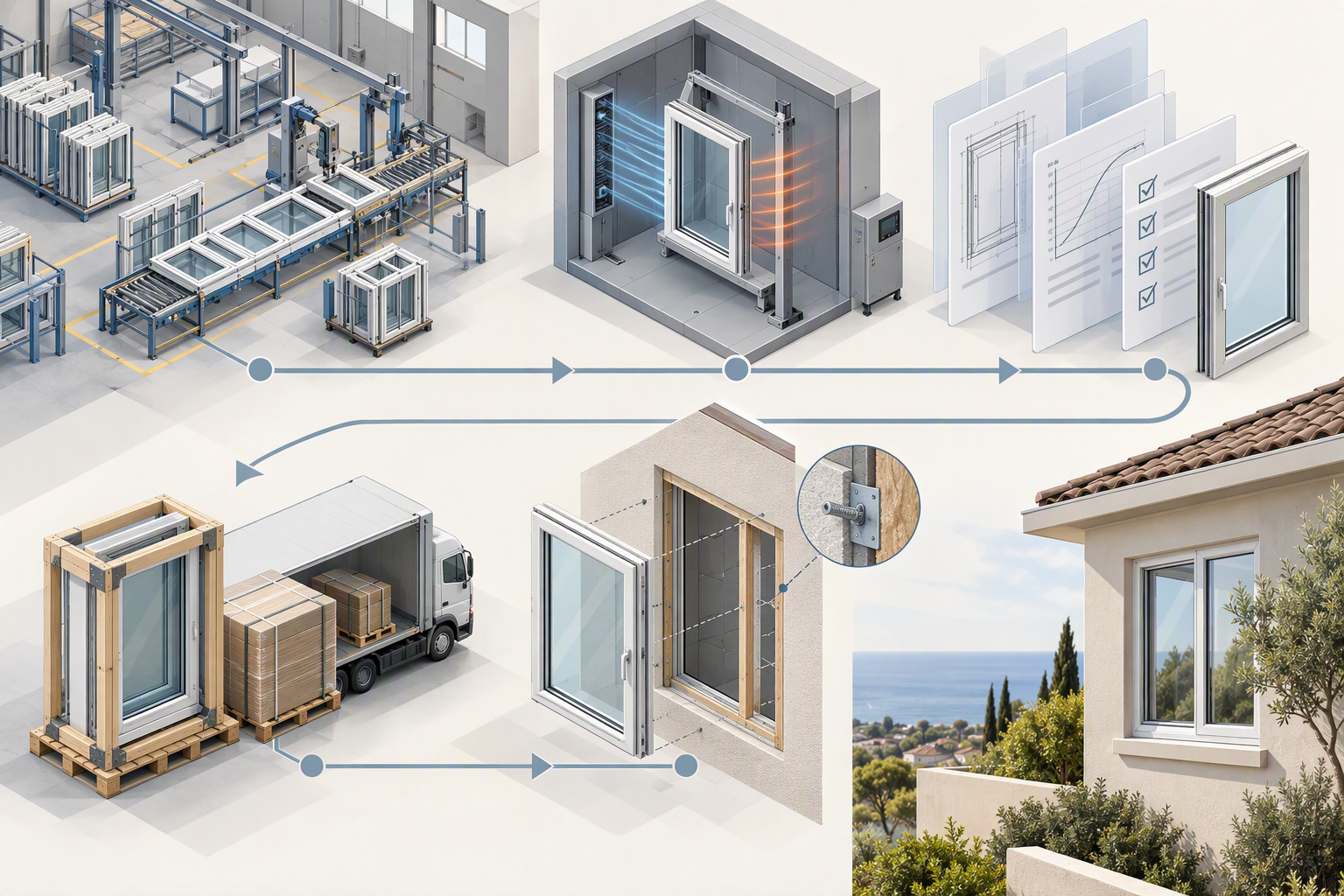
At the kitchen opening, the drawing calls for a frame made to the width between the returns. The appeal is that exact fit: the glass meets the room where the designer intended. Before the factory releases the order, though, the deposit paperwork needs a different kind of fit. If the packet contains a CE marking and a declaration of performance, which document connects this particular window to the testing and labeling route the project will use? Ensure all Imported Window and Door Documents are in order.
The short answer: Identify the unit’s route under R609 before paying the deposit. For exterior windows and sliding doors, the text names testing by an approved independent laboratory and a label indicating compliance with AAMA/WDMA/CSA 101/I.S.2/A440. Keep the decorative-glazed-openings exception, the alternatives for side-hinged doors and the separate R609.5 route in view. Ask the supplier to identify the route for the quoted configuration, then have the plans examiner confirm what the project must submit. Inference: a CE declaration by itself does not appear to establish this route; confirm with the plans examiner.
Having the proper Imported Window and Door Documents is crucial for compliance.
This is a document-planning guide for detached one- and two-family dwellings and townhouses within the 2025 California Residential Code’s scope. The adopted scope text, includes height and egress conditions and additional exceptions; have the project team confirm applicability. Projects outside that scope, garage doors and windborne-debris provisions are outside this article.
Source and version limit: The code provisions below use the adopted R609 text. The supervisor read the adopted code in a real browser on 2026-11-02. The page banner reads “2024 IRC Amended, Effective Date: Jan 01, 2026, Version: Jul 2025 (Historical)”. Local amendments and later supplements are unchecked. This is source retrieval, not professional review. Confirm applicability with the plans examiner before relying on a route for an order.
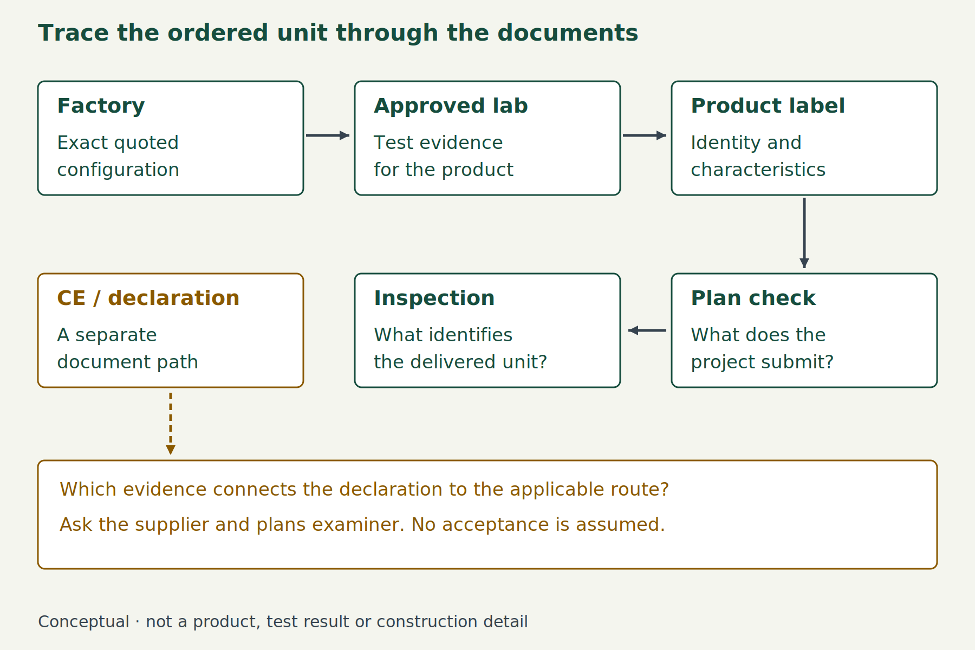
Inference: a CE declaration by itself does not appear to establish this route; confirm with the plans examiner. The arrows trace questions, not an approval sequence.
Conceptual editorial drawing, not an EWD product, label, laboratory record or compliance determination.
R609.3 joins a physical object to a document: the window or sliding door is tested by an approved independent laboratory and bears a label identifying the manufacturer, performance characteristics and approved inspection agency. The useful question is therefore more exact than whether a factory has tested something in its catalog. Which tested product does the proposed unit belong to, and what identifying label will it bear?
For planning, trace that connection from the factory to the test evidence, then to the label, then to the documents the plans examiner needs and the identification the inspector expects to see. This sequence is an editorial way to organize the inquiry; it is not a code-prescribed submission timetable. Ask for the relevant label information while changes to the order can still be discussed.
Inference: R609.3 names the independent-lab test and label to the named North American standard; it does not name CE marking or a declaration of performance as substitutes. A CE packet by itself therefore does not appear to establish that route; confirm with the plans examiner. This is a reading to put to the plans examiner, not a finding that a European product will be rejected. Nor does it answer whether the building department accepts the particular laboratory behind a label. If the laboratory is accredited outside North America, will that department accept its role and documentation for this exact unit?
The code does not give every exterior opening an identical paperwork route. Keep these distinctions attached to the request:
| Proposed assembly | R609 route in the saved reproduction | What to ask the supplier and plans examiner |
| Exterior window or sliding door | R609.3: approved independent-lab testing; label identifying manufacturer, performance characteristics and approved inspection agency; AAMA/WDMA/CSA 101/I.S.2/A440 | Which tested configuration covers the unit, and what label will it bear? |
| Exterior side-hinged door | R609.3: tested and labeled to AAMA/WDMA/CSA 101/I.S.2/A440 or ANSI WMA 100, or compliance with R609.5 | Which of those routes is proposed? Do not assume the window route applies unchanged. |
| Decorative glazed opening | Express exception to R609.3 | Does the proposed opening fall within that exception, and what other requirements apply? |
| Exterior window or door assembly outside the scope of R609.3 or R609.4 | R609.5: testing to ASTM E330; its separate glass requirement remains applicable | Does this assembly belong on that route, and what evidence will the department require? |
R609.4 concerns garage doors and is included in the last row only because it defines R609.5’s boundary. This guide does not interpret the garage-door provisions. The plans examiner must resolve the assembly’s classification; choosing a less demanding-looking row is not a documentation strategy.
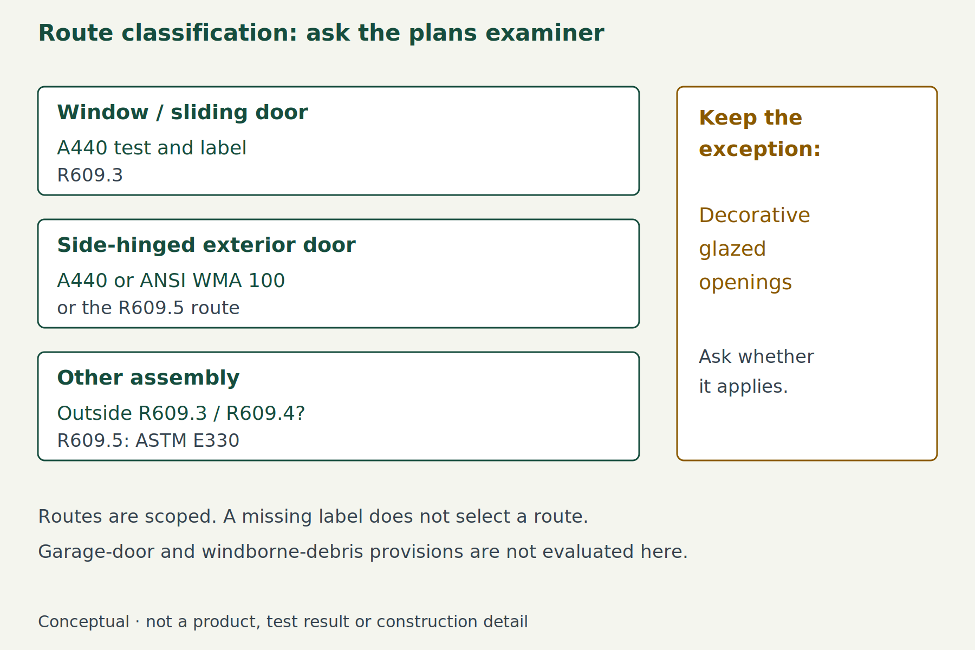
The decorative-glazing exception belongs beside the route map. The other-assembly route is scoped; it is not a universal substitute for a missing label.
Conceptual editorial drawing; the plans examiner determines applicability. No EWD product or compliance result is represented.
The Window & Glass Association of New Zealand’s international-standards guide supplies useful context: A440 uses performance classes and grades, with air, water and structural requirements. That is trade-association explanation, not California authority. Ask which class and grade the proposed configuration has; this article offers no conversion from a European class to either. A test pressure on a declaration is not enough information for this guide to make that translation.
Keep the energy label as a separate document: the energy-ratings guide owns label reading, while Article 11’s European-rating comparison is link pending.
The safety-glazing designation is another inquiry, owned by Article 13, link pending.
R609.1 also calls for the manufacturer’s written installation instructions for each window or door; Article 14 owns their connection to the framed wall, link pending.
These are adjacent questions, not proof that one document satisfies the others. The broader coastal-opening guide owns exposure planning. The quote-scope checklist owns the commercial scope, and premium-door quote comparison owns bid comparison. Article 6’s wall-opening scope guide is link pending. Wildfire-related requirements may raise a separate project question and are not evaluated here.
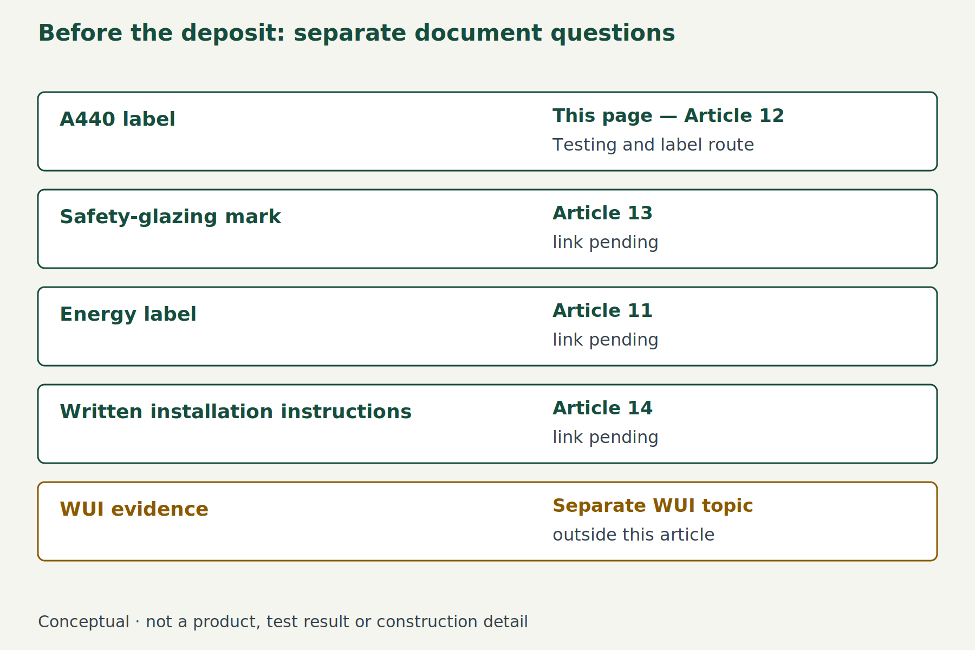
The map assigns each document question to its owning page. A sibling marked link pending has no live destination here; WUI is outside this article.
Conceptual editorial drawing, not an EWD product, document, label or compliance determination.
Good fit: use this document map when a homeowner or designer has a particular imported unit on a quote and can still ask the supplier to connect that unit to the proposed code route. It helps distinguish a question about documentation from a preference about frame proportions.
Poor fit: it cannot approve an unlabeled assembly, decide that an opening is decorative, establish a laboratory’s acceptance or cover a project outside the Residential Code’s scope. A packet containing only a CE declaration and no identified R609 route is a reason to pause the deposit and resolve the route, rather than assume either acceptance or rejection.
The answer can change with the assembly type, jurisdiction, exact configuration and ordered size. R609.3.1 permits structural wind-load design pressures for units different from a size tested in accordance with Section R609.3 to differ from the tested unit’s design value when determined through its stated comparative-analysis methods. That provision is limited to structural wind-load design pressures; it does not establish a blanket transfer of every performance characteristic to an altered unit. Ask who supplies the applicable analysis and how it connects the tested size to the order. This guide does not interpret the methods or assert how often they are used.
Bring the supplier and project team the exact quoted assembly and ask them to complete this list before treating the order as settled:
– Identify the applicable R609 route, including any proposed exception, for that assembly.
– Identify the test evidence, manufacturer, performance characteristics and inspection agency behind the proposed label, where that route requires one.
– Identify the tested size and ordered configuration; ask what supports any size difference under the applicable route.
– Ask the plans examiner which documents to submit and whether the named laboratory and proposed documentation are acceptable for this project.
– Locate the adjacent energy, safety-glazing and installation documents without treating them as substitutes for the testing-and-labeling inquiry.
Making a frame to the opening’s proportions can settle the design drawing while leaving the evidence question open. Before the deposit, the useful connection to establish is between the unit that was tested and the size and configuration the factory will actually make. For an ordered unit different from a size tested in accordance with Section R609.3, ask which applicable comparative analysis supports any different structural wind-load design pressure, and put its responsibility and acceptance question in the deposit file while the order can still be discussed.
Ask the supplier which R609 route the quoted unit takes, and request the label or test documentation behind it for the project team’s review. If bringing that packet to EWD, include the exact configuration and the plans examiner’s open question.


 (310) 200 3931